Pet Sitter Tips for Introducing Dogs

Whether it’s meeting other dogs on a walk or sharing space with other pups during boarding, it’s important for pet sitters to know how to introduce dogs safely. Rushed or unplanned greetings can be stressful for all involved, while slow, thoughtful introductions can set both dogs up for success.
Choosing when, where, and how to make an introduction is key. And sometimes the best choice is to avoid introductions completely. Keep reading for our best tips on how to prepare for and facilitate meetings between pups.
Learn About Your Rover Dog
The more you know about a dog, the better you’ll be able to predict the kinds of conditions they’ll thrive in when greeting other dogs. Your client is a great source of information.
Here are some questions to ask your client before watching their dog:
- Are you comfortable with your dog meeting and interacting with other dogs?
- How does your dog typically respond when they encounter other dogs?
- Has your dog ever had a negative reaction to meeting another dog?
- Does your dog ever exhibit signs of leash reactivity or resource guarding?
- How do you typically introduce your dog to other dogs?
- Is your dog dog-selective (meaning they like some dogs but not others)?
Have Dogs Meet on Neutral Ground or Outside
Once you have an idea of how your Rover dog will react during an introduction, the next step is to create an ideal environment during meet and greets or drop-offs. Here’s what that process might look like:
- Choose a location that’s unfamiliar for both dogs but has plenty of things for them to sniff and explore—like a quiet park or a low-traffic neighborhood street.
- Make sure both dogs are properly restrained with a well-fitted harness and sturdy leash.
- Bring both dogs to the area at the same time and walk them parallel to each other while maintaining a distance of 15 to 20 feet.
- Give each dog a treat when they look at the other to help them form a positive association.
- Let one dog move ahead of the other for a while, then reverse direction so the other dog is in front.
- Repeat until both dogs are walking calmly, then gradually close the distance between them.
- As long as both dogs are calm, let them greet each other and continue to explore the surrounding area.
- Keep the leash loose, using treats to lure your dog away if they start to show signs of tension.
- Walk the dogs next to each other for a little while, continuing to offer treats, but let the dogs sniff and explore as desired.
- When the dogs are fully comfortable with each other, you can try an off-leash interaction in a large, enclosed (ideally neutral) area.
You won’t always be able to facilitate an introduction on neutral ground, but it’s worth it when you can. It’s particularly beneficial if you’ll have multiple dogs in your care at once, as it gives you a chance to check for compatibility. If issues arise on neutral ground, they’re not likely to improve when the dogs are kept in close quarters.
CBCK-Christine via iStock
Clear the Area of Toys, Treats, and Food
Before the dogs share space indoors or outside in a yard for the first time, it’s important to clear the area of any toys, treats, food, or other high-value items. Even if neither dog has been known to display resource guarding behavior, it’s best to exercise caution. Bringing a new dog into another’s perceived territory can ignite a desire to protect the things they value out of fear it might be taken from them.
Once the dogs have spent enough time together for you to gauge that neither is possessive of items, you can slowly introduce resources. Always make sure, however, each dog has their own toys, bed, and food and water bowl so they feel like they’re on equal footing. If conflict does occur when introducing these items, separate the dogs during feeding and sleeping times by using a pet gate or crate.
Keep an Eye on Body Language
Body language is the most important thing for a pet sitter to monitor when introducing dogs for the first time. Not only does their body language communicate a specific message to the other dog, but it can help you tell how they’re feeling about the interaction.
Think of it like a conversation. Healthy interactions between dogs feel like a balanced back-and-forth. Problematic interactions, on the other hand, may feel one-sided, tense, or overwhelming for one of the dogs.
Signs the introduction is going well
Here are some positive body language signs that an introduction is going well:
- Interest in the other dog
- Loose or wiggly body with no visible tension
- Initiating interaction or play (look for behaviors like play bowing)
- Taking turns (one dog chases, then they switch)
- Relaxed facial expressions with soft eyes and loose tongues
- Tails carried at neutral height or slightly raised
- Ears relaxed or perked slightly forward
- Tails wagging in wide, sweeping motions
- Taking breaks to shake off, drink water, or sniff around
Even if both dogs appear calm and comfortable, it’s still important to move slowly. If one dog’s body language shifts, consider it a sign you need to slow down or return to the previous step for a while longer.
Signs you need to stop or slow down the interaction
Here are some body language warning signs to watch out for:
- Frantic or chaotic movement
- Rough play or forceful body contact
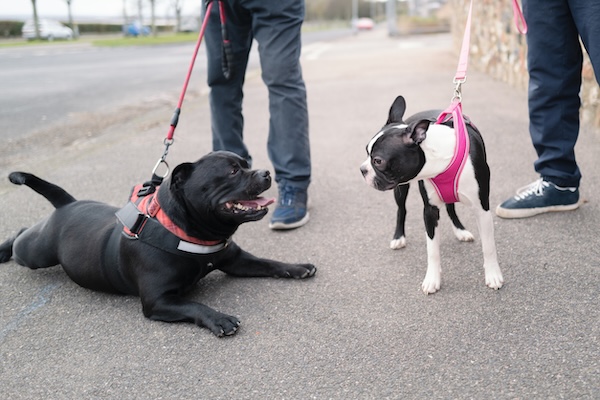
- Tense muscles or tight facial expressions
- One-sided play or mounting
- Wide eyes with the whites showing (known as whale eye)
- Fixed, direct staring with stiffened posture
- Growling, snarling, or snapping
- Hiding or trying to escape the interaction
When it comes to body language, it’s important to look at the whole dog. A wagging tail could indicate happiness if it’s paired with a loose, wiggly body and soft eyes. But when combined with tense muscles and an intense stare, a quickly wagging tail could indicate overstimulation or aggression.
Be Aware of On-Leash Tension
Some dogs behave very differently when they’re on a leash versus when they’re off-leash. Dogs who are leash reactive may growl, bark, or lunge at other dogs because they feel vulnerable when they’re restricted by a lead.
Even normally mild-mannered dogs can be leash reactive, so it’s important for pet sitters to discuss the matter with pet parents ahead of time. For these dogs, off-leash introductions may be the better option.
However, the following should be confirmed before an off-leash introduction takes place:
- Both dogs are well-socialized and generally friendly with other dogs
- Neither dog has previously displayed resource guarding behavior
- Both dogs are trained to reliably respond to a recall cue
- Neither dog has a history of snapping at or biting other dogs
It’s important to do off-leash introductions in a large, controlled environment so the dogs can’t escape. Consider letting your Rover dog drag the leash instead of removing it entirely. That way, if the interaction starts to go south, you can quickly regain control.

krblokhin via iStock
When To Say No to Introductions
Sometimes the best thing you can do when caring for dogs is set boundaries—especially if you’re in new or unfamiliar territory. In fact, some sitters make it a policy not to introduce a Rover dog to unfamiliar dogs on walks at all.
Here are some sample situations where it may be better not to introduce dogs:
- If your Rover dog is an intact male or a female in heat
- If you’re in a crowded or confined space and the dog appears anxious
- If your Rover dog is leash-reactive around other dogs
- If you’re not confidently able to interpret your Rover dog’s body language
- If your Rover dog is dog-selective
- If you’re not confident you can restrain your Rover dog if they pull or lunge
- If your Rover dog is not fully vaccinated (typically puppies)
If you’re avoiding introducing your Rover dog to other dogs on walks, you’ll want to be proactive. When possible, choose places to walk that are less likely to be crowded. When you do encounter another dog, try to maintain your distance. Turn around, cross the street, or step off the sidewalk to allow them to pass.
It’s also a good idea to be prepared to speak up politely if another dog’s owner doesn’t take the hint. A simple phrase like “my dog is in training” or “we’re not meeting other dogs today” will often do the trick.
How To Communicate Your Approach to Pet Parents
As a pet sitter, it’s important to not only decide what your boundaries and policies are, but to be able to communicate them clearly. A little communication goes a long way in avoiding mishaps and misunderstandings with clients.
Here are some strategies for communicating your policies to pet parents:
- Start with some background. Pet parents want to know their pup will be in good hands, so it helps to establish trust by providing information about your credentials and experience early in the booking process.
- Ask plenty of questions. Gather as much information about a potential canine client as possible. Ask specific questions about the dog’s temperament, training, and tendencies when interacting with other dogs.
- Use accessible language. Avoid using technical jargon when asking questions or communicating policies. Rather than asking “Is your dog leash reactive,” ask “Does your dog bark, pull, or lunge at other dogs when they’re on a leash?”
- Establish clear boundaries. If you don’t feel comfortable handling specific situations or working with dogs with certain triggers, say so. It’s better to be confident in the services you provide than to put yourself and your canine client at risk.
- Be clear and concise. Be direct when communicating policies to avoid potential misunderstandings. Avoid overwhelming the client with too much information and ask if they have any questions about your policies before you confirm the booking.
Upfront communication helps establish expectations early on. It can also help redirect potential clients (both human and canine) who might not be the right fit, and give pet parents who do book with you greater confidence in the experience.
Thanks to Alexandra Bassett, CPDT-KA, a certified professional dog trainer and the founder of Dog Savvy Salt Lake City, for suggestions and advice.