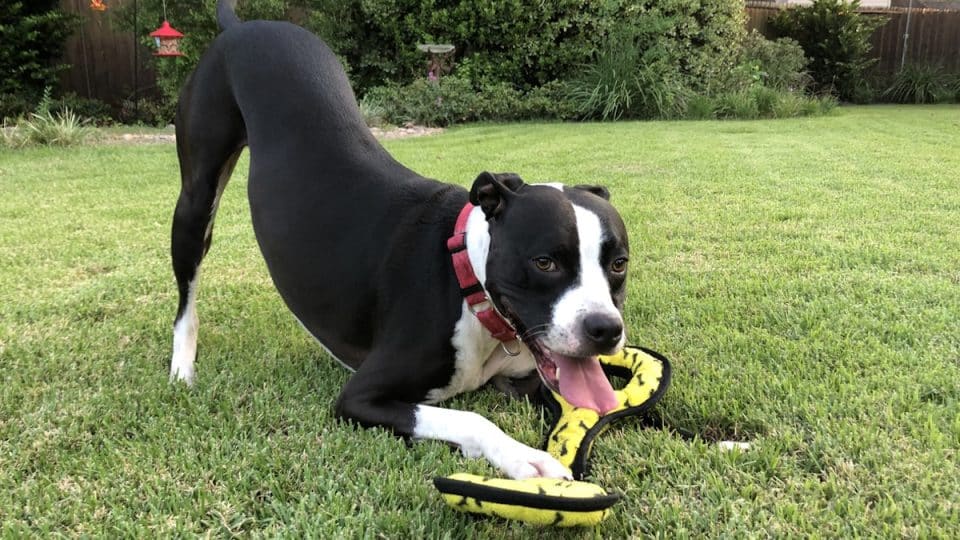
If you’ve ever seen your dog greet another dog with a deep bow, it’s their way of saying they’re ready to have some fun.
“A play bow is a posture where the dog lowers its front end, stretching the front legs with elbows on the ground, while keeping the hind end raised,” says Jamie Walker, a fear-free certified professional dog trainer (CPDT-KA, CPDT-KA, CCDT) with Tucker Pup’s Pet Resort in Chicago.

This play stance in dogs likely evolved through positive repetition out in the wild. Dogs often move into a long, luxurious stretch after resting and before becoming active—so in time, the pose became a signal that play time was coming. These days, dogs use a play bow to show they’re friendly, to mitigate conflict, to say hello, and, of course, to invite another animal to play.
Read on to learn how dogs use play bows with other dogs, why your dog may play bow to you (and if you should play bow back), and how to teach your dog to adopt this playful pose on cue.
Why Dogs Play Bow to Other Dogs
“A bow is most commonly an invitation to play and may be paired with a playful bark, grin, or other loose, wiggly body language,” says Walker. “Beyond signaling play, dogs may also use the play bow to diffuse tension or de-escalate a situation.”
Harleigh Poulson, a certified dog trainer with VCA Willow Creek Pet Center, adds that dogs also use play bows during play to check in with each other or invite a role reversal (like having the chaser be the chased). She suggests thinking of this posture like a “punctuation” in play.
“A play bow ‘punctuates’ the interaction, signaling that everything is okay,” she says. “Mid-play bows are often a signal to pause or reset. Dogs also use other ‘punctuations’ like play sneezes, which serve the same purpose: reassurance that everything is still friendly and everyone is having fun.”
Does a play bow mean dogs will get along?
While play bows are important in dog-to-dog communication—helping keep intentions clear, safe, and fun—it’s still essential that pet parents monitor playtime. A play bow is a good start to an interaction, but it doesn’t guarantee that things will continue smoothly.
Walker recommends keeping an eye out for red flags in dog play. “Stiff, tense body posture, height-seeking behaviors such as rearing up on hind legs, side-eyeing, or excessive mounting can signal that playful banter may be escalating into real tension,” she says.
What It Means If Your Dog Bows to You
If your dog is play bowing at you, they’re likely either doing so as a greeting or as a request to interact with them.
For instance, if you’ve been away all day and come home to your dog bowing at the door, it’s safe to bet they’re saying hello. Along with a greeting bow or stretch, your dog will also likely be making direct eye contact and happily wagging their tail.
Other times, just like with fellow playmates, your dog may bow at you to initiate a playful interaction. This stance will be much quicker and bouncier than a greeting bow, with bright eyes and a loose, wiggly body. Your dog may even bring you their favorite toy to initiate a game of tug or fetch.
Ultimately, a play bow shows that your dog trusts you and feels safe communicating with you. The best way to respond is to reciprocate those feelings back with a greeting, skritches, or by playing with your dog.
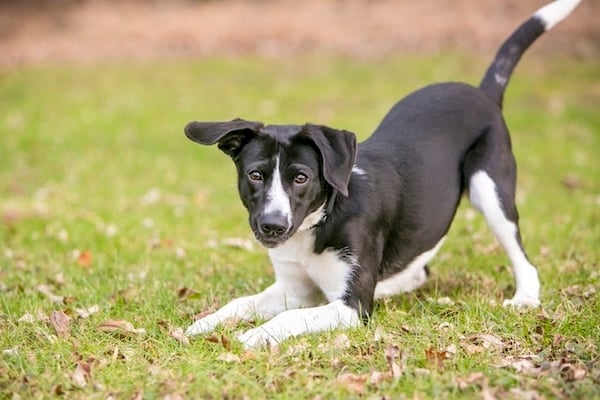
Mary Swift via iStock
Can You Play Bow to Your Dog?
What if you want to get your dog’s attention and let them know you’re ready to start a game—can you play bow to your dog? Yes, you absolutely can!
Here are a couple of ways to mimic this dog play pose, starting with the most obvious:
- Lower onto your hands and knees until you’re on all fours
- Place your elbows on the ground and stretch your arms out
- Bow deeply with your head down and your butt up
You can also play bow while standing by:
- Hinging at the hips
- Dropping your chest
- Spreading your arms out
The key to both options is to make your movements quick and sharp. It may take your dog a while to catch on, but you can help them by following the bow with a playful action like running away for a game of chase or tossing a ball. Once your dog figures out what you’re doing, they’ll likely respond with their own play bow, bounce or jump excitedly, or bring you a toy.
While you may think it’s silly at first, a play bow can be a great tool during training, acting as a fun, non-verbal way to encourage engagement. Use it to reward your dog for preferred behavior or to reset the energy during a training session to keep things positive and playful.
Can You Teach a Dog to Play Bow?
Play bowing is especially helpful for puppies learning to interact with other dogs. “Puppies often learn behaviors from their littermates and their mother,” says Poulson. “Through trial and error, they figure out which actions get a positive response, such as more play, and which do not.” She adds that even though adult dogs play differently from puppies, they carry the play bow into adulthood as a universal “let’s be friends” signal.
If you have a dog who missed out on early socialization with littermates, you can help teach them to play bow by mimicking it yourself before play. You can also teach it as a trick and put it on cue by breaking it down like this:
- Begin with your dog in a standing position
- Use a treat to lure their head downward, helping keep their back and rear-end upward
- Reward this body language and then initiate play
- Add a cue once they understand this motion
While you can train play bow as a trick, Walker recommends not cueing it during dog-to-dog interaction, as it may create confusion and put your dog in a bad situation if they’re not actually interested in playing. Instead, use this training as a fun way to strengthen the bond between you and your pup!