
- Not a substitute for professional veterinary help.
Dogs may be our best friends—but that doesn’t mean they’re always easy to understand. That’s especially true when it comes to body language and behaviors that can mean different things in different contexts. Dogs looking upward is a prime example.
When a dog looks up, they may be glancing upward to communicate with you, request attention, or check your body language. Or they could be tracking a sight, sound, or smell that only they can sense. In some cases, looking upward can even be a sign of a medical problem—in which case it’s important to get to the vet early.

To learn how to interpret dogs looking up, we spoke with Dr. Jamie Whittenburg, a veterinarian with over 20 years of experience and the veterinary director at Senior Tail Waggers. Here’s what to know.
1. They’re Communicating With You
Dogs have many different ways to communicate with humans. Sometimes it’s a tail wag, and other times it’s a bark or a sneeze. Looking up at you is one way to communicate, especially when your dog wants to get your attention or gauge your body language.
Getting attention
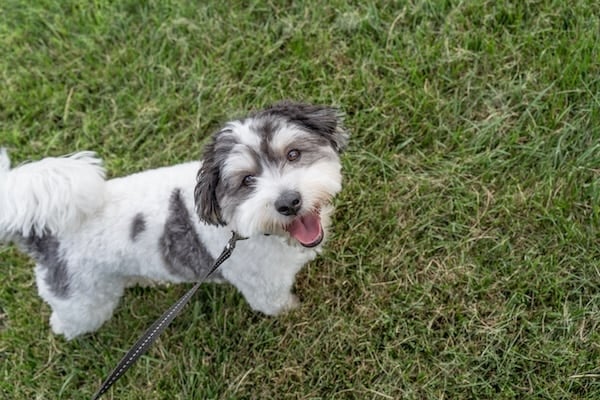
Dogs often look up at us as a reliable low-stakes way to initiate interaction and request resources. It’s a natural behavior that’s been reinforced by thousands of years of domestication. Plus, it’s likely been reinforced by you, if you regularly respond with praise, a treat, or a smile.
If your dog is repeatedly looking up because they want your attention, you might see the behavior escalate into higher-stakes requests like pawing, whining, barking, or jumping—especially if you’re not responding to their puppy dog eyes.
Reading your body language
Dogs may also repeatedly look up at you to gauge your reaction to what’s happening. They may watch your body language or follow your gaze to decide how to feel and behave. A nervous dog, for example, might watch your body to determine whether a newcomer is a threat or a storm is a danger.
If your dog is repeatedly looking up at you, they may be anxious, alert, curious, or expectant. Watch their body language to get a sense for what might have them paying extra attention to you.
-

arlutz73 via iStock
2. Their Powerful Senses Detect Something
If your dog is looking up a lot, they might be sensing something that you can’t. After all, a dog’s sense of smell is roughly 10,000 times more accurate than ours, their eyes are better at motion detection, and their ears pick up sounds we can’t even hear.
Sounds
Dogs can hear sounds at higher frequencies and from greater distances than we can. They might look up instinctively to track a sound that human ears can’t perceive, such as a faraway plane, mice or critters in the walls, or a leaky pipe. The behavior might be repeated if the noise persists.
If that’s the case, expect to see your dog looking up with a focused gaze and a sudden change in posture. You might also see your dog’s ears twitch and rotate.
Scents
Dogs have an incredible sense of smell (especially Bloodhounds, Beagles, German Shepherds, and Basset Hounds) and often lift their noses to sniff, which could cause them to look upwards briefly. If your dog is tracking a scent on the air, they might repeat the behavior.
Sight
Dog eyes are powerful motion sensors—so if your pup is looking up repeatedly, they might be tracking a bug or shadow overhead. You might also see signs of alertness, such as standing still, ears perked forward, and a focused gaze.
Note that if your dog’s senses are the reason they’re continually looking up, the behavior should be tied to a specific environment. For example, your dog might look up frequently in a house with critters in the ceiling—but the behavior should stop when they’re outside or in a different location. If the behavior transcends a single spot, it’s time to consider other causes.
-
miljko via iStock

3. Medical Causes
If your dog is repeatedly looking upward without any obvious cause, it can be a sign of a neurological disorder or musculoskeletal condition. This behavior, sometimes called “stargazing,” is usually characterized by a fixed upward gaze and a rigidly extended neck.
If your dog is stargazing, it’s important to get them in for a checkup right away. Here are the medical conditions that might be to blame and the related symptoms to watch for.
Focal seizures
Focal seizures happen when there’s an abnormal surge of electrical activity in a dog’s brain. Unlike generalized seizures that affect the whole body, focal seizures are usually centralized, making them trickier to spot. Look for isolated twitching or other repetitive behaviors, like circling or fly biting.
Brain tumors
Brain tumors are abnormal growths in your dog’s brain. In addition to head tilting, you might see symptoms like balance issues, seizures, vision problems, and behavioral changes.
Vertigo (vestibular disease)
Vertigo, a common symptom of vestibular diseases, is a balance issue caused by your dog’s inner ear and brain. Your dog might feel dizzy even when they’re standing still. Look for a loss of balance and a reluctance to stand or walk. With quick vet treatment, many dogs recover completely.
Cognitive dysfunction syndrome
This is a neurological disorder in dogs that causes memory loss, disorientation, and potentially changes in social behavior and sleeping patterns. This is significantly more likely to affect senior dogs than younger pups.
Hydrocephalus
Hydrocephalus is an excess of cerebrospinal fluid (CSF) in a dog’s brain. This is more commonly diagnosed in small, short-nosed breeds, like Boston Terriers, Chihuahuas, and English Bulldogs. Other symptoms include head pressing, difficulty walking, or seizures.
GI pain or acid reflux
Dogs may look upwards if they’re experiencing gastrointestinal pain, have something stuck in their esophagus, or are feeling the effects of acid reflux. Other signs of acid reflux in dogs include lip licking, lack of appetite, pain or whining, and excessive drooling.
Vision issues
A dog repeatedly looking up can signal that your pup is having vision problems, which may be caused by retinal disease or cataracts. Consider if your dog is taking longer to identify objects at a distance, struggles to navigate in dim light, or has slowed down on walks.
When Should You Go to the Vet?
While dogs might look up for a lot of reasons, if you notice it happening frequently along with other sudden, new symptoms, it’s best to consult your vet. “If the behavior is persistent (more than a few seconds), is occurring frequently, or associated with other signs such as stumbling, pain, changes in appetite, or disorientation, then it’s time to see a veterinarian,” explains Dr. Whittenburg.
Dr. Whittenburg says you can expect your vet to start with a thorough physical and neurological exam to look for signs that might point to a specific issue. You can help your vet hone in on a diagnosis by bringing a list of the other symptoms you’re noticing.
Your vet may also order blood work to check blood counts and organ function, or advanced imaging, such as an MRI, CT scan, or X-rays, if a spinal or brain disease is suspected.
Catching health problems early can make a huge difference in your dog’s prognosis and comfort—so if you’re on the fence about stargazing, consider giving your vet a call to rule out more serious conditions.