- This post contains affiliate links. Read more here.
- Not a substitute for professional veterinary help.
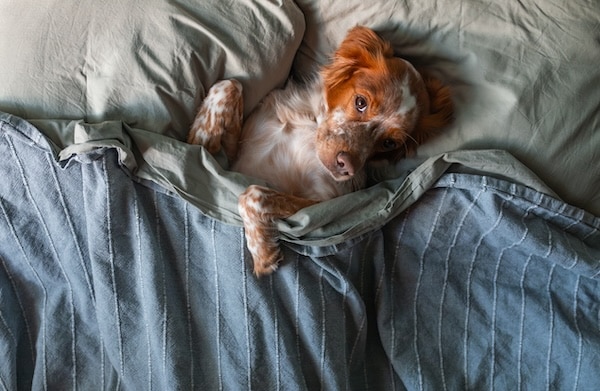
Some people love snuggling up with their pup at the end of a long day. For others, sleeping with a dog on the bed is nothing short of a nightmare.
Pet parents are generally divided: nearly half of Americans report co-sleeping with a pet, according to a recent survey from the American Academy of Sleep Medicine.

Wondering which is right for you? To explore the benefits and drawbacks of letting your dog sleep in your bed, we spoke to Allie Bender, certified dog trainer (CPDT-KA) and founder of Pet Harmony Animal Behavior & Training. With her help, we review common co-sleeping misconceptions and discover how to handle training challenges.
Busting Myths About Letting Your Dog Sleep in Your Bed
Before we dive into the real benefits and concerns with bed sharing, let’s cover some of the most common misconceptions.
It convinces your dog they’re the alpha
The outdated and scientifically disproven canine dominance theory suggests that dogs naturally divide themselves into social hierarchies. According to this theory, pet parents must establish themselves as the “alpha” of their dog’s pack.
Letting your dog share your bed, then, puts them on equal footing instead of keeping them submissive. We now know that not only is alpha dog theory flawed, but dominance-based training methods can cause a lot of harm.
It causes separation anxiety
Researchers have found no correlation between co-sleeping and separation anxiety. Many anxious dogs sleep alone every night, and many confident dogs prefer to sleep with their owners.
The origin of this myth likely comes down to confusion between attachment and dependence. It’s natural for a dog to develop a genuine attachment to their owner. However, if they panic when separated, it’s a sign of a deeper issue and not simply a sleeping preference.
Co-sleeping with your pup is a modern trend
There’s nothing new about humans sharing their beds with dogs. In fact, the practice of co-sleeping dates back to the early days of canine domestication when dogs and humans slept together for warmth and protection.
Archaeological evidence dating back 14,000 years even shows dogs being buried alongside their humans. Several have been found with the person’s head resting on the dog in a mirror of how they may have slept.
Your dog will be sad in their own bed
Every dog is different, and there’s no reason to assume yours will be unhappy sleeping in their own bed. Bender, a professional dog trainer, says the best way to find out whether your dog really prefers sleeping in your bed is to offer them multiple options.
Even dogs who love snuggling may prefer to sleep alone, she adds, especially if their humans tend to toss and turn all night.

Akifyeva Svetlana via iStock
Reasons To Let Your Dog Sleep in Your Bed
Science shows there are some very real benefits to sharing a bed with your dog. Here’s what you might gain.
Bonding
Several studies have demonstrated that humans who share their beds with their dogs are likely to be more emotionally involved with their pups. An Australian study from 2021 also tested the theory and found that owners who co-slept with their dogs reported higher levels of emotional closeness.
Better sleep
Some people simply sleep better with their dog nearby. According to the previously mentioned American Academy of Sleep Medicine survey, nearly half (46%) of people who sleep with a pet report they sleep better with a furry friend.
People who co-sleep with their dog often say they feel safer at night and fall asleep more quickly. Sharing a bed with a pet has also been shown to reduce symptoms of sleep disorders like insomnia, and even nightmares caused by post-traumatic stress disorder (PTSD).
Reduced anxiety, depression, and loneliness
Sleeping next to your dog could trigger the release of oxytocin, the “love” hormone that plays a role in feelings of closeness and trust. Oxytocin can also help lessen symptoms of anxiety and depression. Simply building a close enough bond that you’re happy to share a bed with your dog may have a positive impact on mental health as well.
Reasons To Avoid Co-Sleeping With Your Dog
Sleeping next to your dog isn’t ideal for everyone. Here are some reasons to consider separate snooze spots.
Worse sleep
Though some people sleep better next to their dog, it isn’t the case universally. Some pet parents might find it hard to sleep next to a dog who snores or acts out their dreams.
Depending on your dog’s size, sharing a bed might make it harder for you to get comfortable. Plus, if you already run hot, you might find the extra body heat next to you unpleasant.
Allergies and hygiene
It’s not necessarily unhygienic to sleep with your dog—especially if you keep up a basic grooming routine. But if your dog is a super shedder or always has a little bit of a doggy smell, you may prefer to keep them off your bed.
For humans who have hay fever or allergies, sleeping in bed with their dogs may not be a good idea. Keeping your bedding allergen-free is a lot trickier than other living spaces, since there’s so much more body contact with sheets and comforters. Along with shedding, dogs can bring grasses and pollens inside and right up to their allergic humans’ pillows.
Parasites pose a danger to both dogs and humans, so it’s important to use flea and tick prevention. The risk of disease transmission may be even higher for people who are immunocompromised.
Resource guarding
While Bender notes that co-sleeping doesn’t directly cause resource guarding, it can become a safety concern with dogs who already have a tendency to guard certain spaces or a particular person. If your dog shows signs of resource guarding, sleeping separately may be a good boundary to keep in place while you enlist the help of a professional trainer.
Kseniya Zhukova via iStock
Should Dogs Share a Bed With Kids?
Whether it’s safe for a dog to share a bed with kids depends on several factors. Individual temperament is a big one, but it’s also important that your kids know how to read and respect dog body language. Even a mild-mannered dog could unintentionally cause harm when stressed or restrained.
From a health perspective, there’s some evidence to suggest children who grow up with pets are less likely to develop allergies. And the hygiene hypothesis states that early exposure to germs may strengthen a child’s immune system. Theories like this are hard to prove, however, and kids who grow up with dogs can still develop allergies, asthma, and other health problems.
If you’re not sure whether it’s a good idea for your dog to be sleeping in the same bed as your kids, talk to your pediatrician. A veterinarian or trainer can also provide useful insight on your pup’s behavior.
What Happens at the Pet Sitter’s?
Some pet sitters will be perfectly happy to let your dog on their furniture (you can even filter for it on Rover), while others may have stricter policies in place. Communication is key to finding the right fit and avoiding unnecessary confusion for your dog.
That said, you don’t necessarily have to rule out a pet sitter who prefers not to share their bed with your dog during an overnight stay.
For better or worse, Bender says, dogs are really good at context. They’re able to learn that different humans have different rules. But if you want your dog to be consistent about staying off the bed, it’s best to consistently enforce the rule across the board.
How To Train Your Dog To Stay Off Your Bed
Whether you’ve tried co-sleeping with your dog and you’re not a fan, or you want to keep your new pup off your bed from the start, there are a few things you can do.
If you’re just starting out
If your dog has never shared your bed, the easiest option is to prevent them from getting used to it in the first place. With a puppy or newly adopted dog, the earlier you start, the better. And once you’ve put a no-dogs-on-the-bed policy into place, be consistent about enforcing it.
Bender recommends providing your pup with alternatives and making them as appealing as possible. Ask yourself what your dog likes about sleeping in your bed over their own.
Is it warmer? Add a cozy blanket. Is it more supportive? Try an orthopedic dog bed. And if they simply like sleeping near you, try placing their bed at the foot of yours. You might even include your dog in your nightly routine and tuck them in, so to speak, before heading to bed yourself.
If you’re changing your policy
If you no longer want your dog sleeping in your bed, you’ll still need to provide your pup with a suitable alternative and be consistent in sticking to your new rule, Bender says. This might mean setting up pet gates or keeping the door to the bedroom closed until your dog learns what you now want them to do.
Consistency doesn’t have to mean all or nothing, Bender adds. You might not want your dog sleeping in bed with you, for example, but could choose to invite them up for snuggle time in the morning. As long as you make the rules clear to them, many dogs have no trouble learning new bedtime routines.
If you prefer to keep your dog contained at night, choose a suitably sized crate and make it comfy inside. Use rewards-based training techniques to help your dog develop a positive association with the crate, and never use it for punishment. If your pup learns to feel at. home in their crate, they won’t feel sad about not sleeping in your bed.
Need help teaching your dog to stay off your bed at night? Consider enlisting the help of a professional dog trainer. They can create a customized training plan for your pup, so you both get a good night’s sleep!