- This post contains affiliate links. Read more here.
- Not a substitute for professional veterinary help.
The right dog training tools can make the training process much easier. But it can be hard to know what’s essential and what’s unnecessary, especially if you’re buying dog training supplies for the first time. What basic gear do you need to get started? What’s a must-have, and what can you do without?
To help you in your dog training journey, we’ve compiled a dog training equipment list, with input from two certified dog trainers. In this guide, we’ll cover essential tools all dog parents need upfront and common supplies that aid positive-reinforcement dog training. Plus, we’ll discuss equipment to help manage and modify behavior, as well as more advanced gear for dog parents with big goals.

Essential Tools
Here are some of the best dog training tools to have on hand. This basic gear is critical for keeping your dog safe as you build skills and trust, helping to get them off on the right paw.
Collar
A collar is an essential piece of dog training equipment. It keeps ID tags on your pup, offers a leash attachment point, and doubles as a handle in an emergency. Which type you choose will depend on your pup’s needs.
- Standard flat collars tend to work well for most dogs.
- Collars with quick-release buttons can be a boon for wriggly puppies or dogs getting used to wearing equipment.
- Martingale collars, with their two loops that tighten slightly (but don’t choke) when your dog pulls, can help keep escape artists in their gear.
Pro tip: Regardless of the type of collar, Ali Smith, professional dog trainer and founder of Rebarkable, reminds pet parents to pick a width that’s appropriate for the size of their dog’s neck. While a small dog like a Chihuahua may only need a half-inch wide strap, large dogs like German Shepherds may need a 1.5-inch wide collar, she says.
To avoid: Most pet experts also advise against choke, shock, and prong collars for training, as research shows that these aversive dog training tools can cause real harm.
Harness
For many dogs, a leash attached to a harness provides a safer and more comfortable walking experience than a leash clipped to a collar—especially for pups new to training. That’s because a harness distributes pressure across the chest rather than the neck, making it a better option for dogs who pull, have respiratory issues, or are prone to neck injuries.
Where the leash attaches is an important feature to note when picking out a harness.
- Front-clip harnesses are ideal for large dogs and pups who pull. They make it more difficult to lunge ahead and help gently redirect the dog toward their handler.
- Back-clip harnesses provide more freedom of movement and tend to work best for small dogs, polite walkers, and long-leash decompression walks.
- Dual-clip harnesses have both a front and back attachment point, giving you more flexibility depending on the situation (and the dog). Clip to the front for loose-leash training, then clip to the back for a leisurely sniffy walk.
Pro tip: When choosing a harness, Rachel Lane, certified behavior consultant, dog trainer, and owner of Leash & Learn, recommends looking for models shaped like a “Y” or an “H.” These designs allow dogs to move their shoulder and elbow joints freely.
Leash
A good leash is essential when teaching your dog new walking and training skills, and different lengths serve different purposes. When choosing a leash for your pup, consider how it will fit into your training plans.
- Short leashes, around 4-6 feet long, will fit comfortably in your hand and keep your dog close to you. They also offer more control in busier situations, like city walks and socialization outings.
- Hands-free leashes can make it easier to mark behaviors with a clicker and deliver rewards.
- Long leashes give your dog more freedom while keeping them safely tethered to you. They’re excellent for practicing recall and reinforcing engagement on less structured walks.
Pro tip: Material-wise, choose something tough, like nylon or leather, to hold strong against chewers and pullers. Biothane and waterproof leashes are easy to clean and dry quickly if you live in a rainy or snowy area.
To avoid: Lane advises against retractable leashes, as they offer less control and may snap when pulled suddenly.
-

Rover test pup Roo practices her recall skills on a long leash.

Positive Reinforcement Training Supplies
Positive reinforcement training works by rewarding the behaviors you want to see more of. Having the right dog training tools on hand makes that process faster, clearer, and more fun for both you and your pup. Here’s a dog training equipment list for R+ needs.
Clicker
A clicker helps you clearly mark the exact moment your dog correctly does what you’ve asked. A verbal marker, like an upbeat “yes,” serves the same purpose if you’d rather not carry the device. But a clicker is handy because it’s neutral, consistent, and immediate. It’s especially useful when teaching a brand-new behavior, since the precise timing helps your dog zero in on exactly what they did to get a reward.
Pro tip: If you have a fearful, sound-sensitive dog, look for a clicker with a quieter click. Or try using a ballpoint pen instead. You’ll get the same click but at a softer volume.
Training treats
Treats are indispensable for positive-reinforcement training. The goal is to find something your dog finds truly irresistible—the more motivated your dog is, the faster they’ll learn. Here are a few types of dog training treats to keep in mind when choosing the best option for your pup.
- High-value treats like freeze-dried liver, cheese, and chicken are a must in dog training. These exciting rewards help encourage a dog to learn new behaviors and can help hold their attention in distracting environments.
- Fast-eating treats are perfect when you need to deliver a high rate of reinforcement in high-stakes situations, like helping an overly excited dog stay calm instead of jumping on guests or keeping a reactive dog engaged when walking past triggers. Small, soft (and stinky!) treats work well here, as does a squeeze tube with lickable spreads like dog-safe peanut butter.
- Slow-eating treats, such as long-lasting chews or a stuffed KONG, are ideal for encouraging duration for preferred behaviors, like relaxing in a crate or on a mat for place training.
Pro tip: Hard, large, or crumbly treats usually aren’t very exciting for many dogs. They may also slow down your rate of reinforcement because your dog has to stop and chew.
Treat pouch
A treat pouch might seem like a small thing, but it can make a big difference. “When training a dog, correct timing of reinforcement is an important element for behavior acquisition,” Lane says. “Having a treat pouch gives [pet parents] an easy way to have treats ready, access them quickly, and feed their dog at the right time.”
Two common styles of treat pouches are clip-ons and fanny packs.
- Clip-on pouches that attach to your waistband are a great, lightweight option if you’re looking to carry treats with you.
- Fanny pack treat bags can usually be worn around the waist or across the body and are ideal if you need to carry more gear, such as toys, poop bags, and your car keys.
Pro tip: Things can quickly get stinky! Choose a treat pouch with materials that are machine washable or easy to clean.
Toys
Not every dog is food-motivated. If your dog is less enticed by food and more driven by play, these toys make an excellent reward. Certain toys can also help you build specific skills. For instance:
- Tug and rope toys are great dog training tools for redirecting biting, like a teething puppy attacking your sleeves.
- Balls and fetch toys are excellent dog training aids when you’re working on cues like “drop it” and “leave it.” They’re also great for practicing recall—the fun continues when they come back to you!
- Flirt poles are helpful for teaching prey-driven dogs to self-regulate around exciting stimuli (like rabbits and squirrels). During a training session, you can teach your dog to leave the lure alone until given a release cue.
-

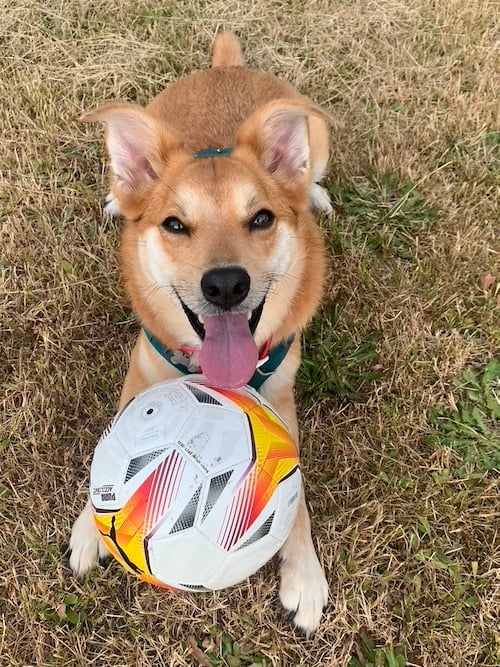
Play-driven Roo loves to chase ball toys as her training reward.
Behavior & Management Aids
Rather than constantly correcting your dog, implementing management can help keep your dog focused and safe. It can also help prevent your dog from rehearsing unwanted behaviors (like chomping on your couch) while you teach them new ones (relaxing calmly in their dog bed).
Here are a few top tools for when your dog needs a little extra training support.
Gates and pens
Pet gates and exercise playpens are some of the most underrated tools in a dog guardian’s arsenal, as they can immediately stop a behavior from happening. They’re especially helpful for puppies and newly adopted dogs who need supervision.
During potty training, use a gate or pen to keep your dog on easy-to-clean floors until they’ve got the hang of it. If your dog has a habit of jumping on people when they walk through the front door, put them behind the barrier until they’ve calmed down. You can also use a gate to teach your dog to wait at doorways until you give them the cue to walk through.
Crates
A crate gives your dog their own dedicated space. When a crate is introduced correctly, many dogs come to see it as a safe, comfortable retreat.
- Wire crates are great for dogs who are still getting used to crate training. They offer good visibility so pups can still keep an eye on their surroundings, helping reduce anxiety. The open design also makes it easy to toss treats in.
- Plastic crates offer a den-like experience for dogs who prefer a darker, quieter space or who are easily overstimulated, distracted during downtime, and need help settling.
- Soft-sided crates are ideal for training on the go, whether at a class or out in the wild when teaching your dog to settle in new environments.
- Heavy-duty crates are built for training dogs with serious chewing or escape tendencies. More durable than standard wire or plastic options.
Pro tip: If crate training isn’t the right fit for your dog, use gates, pens, or a designated room the same way instead.
Training mat
If you have an excitable dog or would like to bring your pup to more public places, a training mat can give them a place to settle and teach them how to relax in a variety of settings. You can bring the mat to outdoor patios, a friend’s house, or wherever you want your dog to have a specific place to chill. You can purchase specialty training mats, but a bath mat, towel, or old yoga mat can work, too.
Pro tip: Experts recommend bringing out this mat only when you intend to use it. The training mat should not be your dog’s regular spot for lounging or sleeping. A slightly raised mat that has a different color from your floor may help your dog notice it. Rubber backing can also prevent slipping—an important feature for lively pups who eagerly dive into position.
Muzzles
Dogs wear muzzles for a variety of reasons, including preventing biting, unwanted attention (for fearful dogs), scavenging, or licking a wound or injury. They’re a great way to prevent risk while working on behavior modification training.
When choosing a muzzle, opt for a properly-fitted basket style design that allows your dog to still pant, drink water, and accept treats.
Pro tip: Gradually introduce the muzzle, rewarding at each step: interacting with the muzzle, sticking their nose in, keeping the nose in for longer times, putting on the strap—and so on. The goal is to eventually have your dog happily put their nose in on their own.
To avoid: Soft/fabric muzzles that keep the mouth fully closed prevent dogs from panting or drinking. Dogs regulate their body temperature through panting, so restricting that for too long can be dangerous.
Head collar
Head collars are designed to give handlers greater control while discouraging dogs from pulling. They can be a good option if a front-clip harness isn’t cutting it for your determined puller.
In general, head collars are regarded as more humane than aversive tools like shock collars when used correctly. However, they won’t solve a pulling problem on their own, and you must use them in conjunction with consistent training and reinforcement. Always use a head collar with a shorter leash and avoid letting the dog hit the end of it at full speed.
Pro tip: Many dogs will find a head collar uncomfortable at first, so they’ll likely need a period of acclimatization. Since there’s a learning curve to these, it’s a good idea to work with a non-punitive trainer to help positively condition the head collar.
Advanced Equipment
Ready to take your training to the next level? If you already have the basics down, you can keep the fun going with some advanced gear. These tools are great for bonding, and they can be a fun addition for both you and your pup!
Scent kits
Nosework is a low-impact activity that most any dog can enjoy, regardless of age, intellect, or athletic ability. It taps into your dog’s natural foraging instincts and provides mental stimulation while strengthening the relationship between you and your pet. You can practice purely for fun or compete through organizations like the AKC and the National Association of Canine Scent Work (NACSW).
- Pre-assembled scent kits make it easier to get started and include all the necessary items, including cotton swabs, essential oils, and mini mason jars.
- A DIY approach where you assemble your own kit with specific scents tailored to the level you’re working at gives you more flexibility as your dog progresses. It’s also a cost-effective option for owners who want to customize their training setup.
Pro tip: Nosework typically starts with teaching your dog to find a specific scent in a simple container, then gradually increases in difficulty, like longer search areas, more hides, and more complex environments. When setting things up, wear gloves and use tweezers to handle the scented cotton swabs before disposing of everything that came into contact with the odor—you want the scent to be a “novel” smell in the environment.
Agility courses
Agility training provides dogs with both mental and physical exercise and helps pups recognize a variety of basic cues, such as “sit, “stay,” “down,” and “come.”
- Compact indoor kits are ideal when the weather is uncooperative or when you don’t have a large enough space outside.
- Sturdier outdoor kits come with obstacles like tunnels, weave poles, and hurdles for jumping. This variety means you can target different skills in a single session, from speed and coordination to focus and impulse control.
Pro tip: Teaching body awareness is a key component of agility training and may be an area you want to focus on. Other great body awareness gear includes balance disks, balance pads, wedges, and yoga blocks.
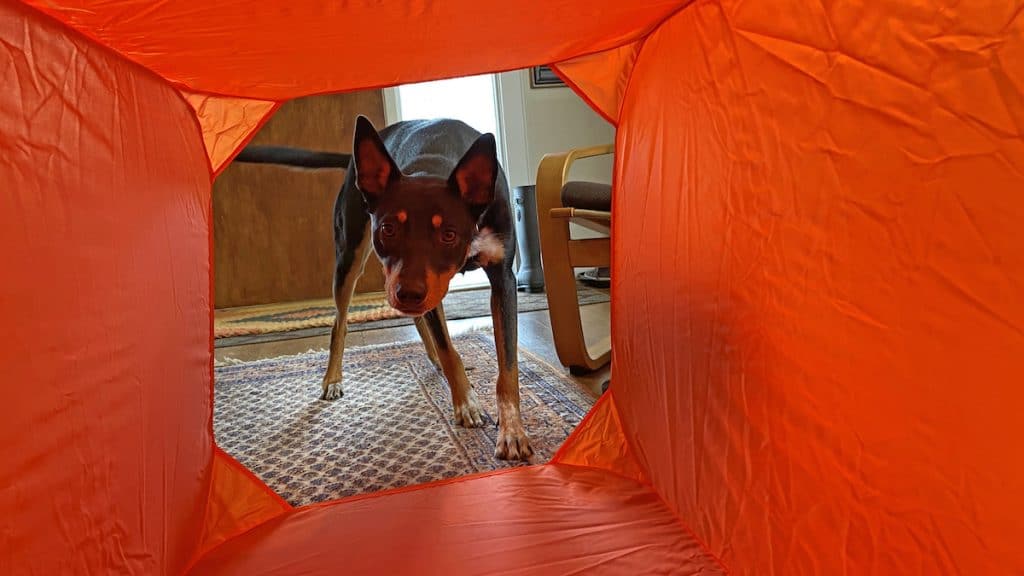
Australian Cattle Dog mix Pepper gives an indoor agility kit a whirl.
Talking buttons
When you’re ready to take things to the next level, you can try teaching your dog to “talk” to you. Talking buttons feature pre-recorded words or phrases that dogs activate by pressing the buttons with their paws or noses.
These buttons allow dogs to “speak” by associating specific words with their needs or desires, offering a unique way for dogs to express themselves and interact with their pet parents. Some talking buttons are better suited to beginners, and others are buildable for advanced learners with a growing vocabulary.
Not all dogs will take a shine to these. But if you’re up for the challenge and ready to invest some time and effort, talking buttons could be fun to try.
Pro tip: In the beginning, keep things simple with high-frequency words like “walk” or “treat” to give your dog a chance to build a clear association between the button and the outcome before expanding their vocabulary.