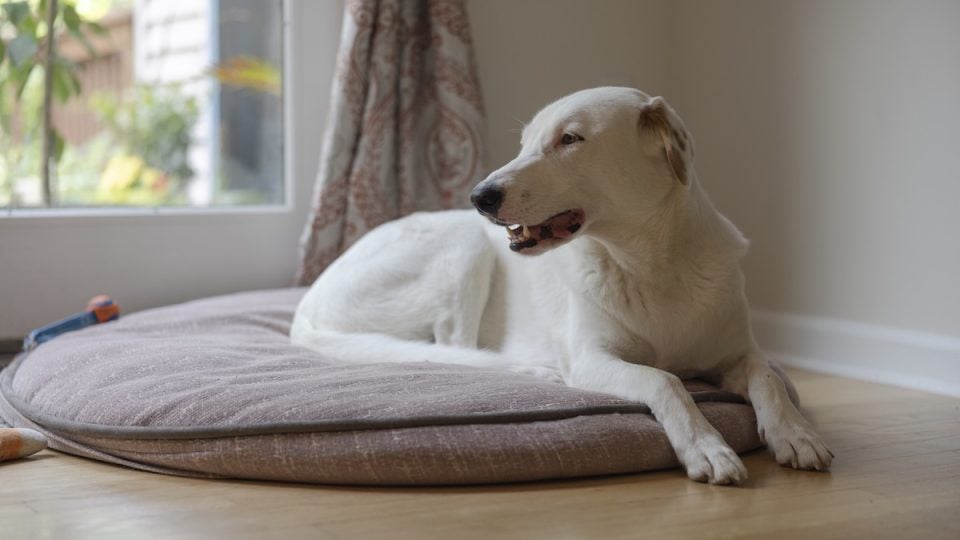
Dog place training involves directing your dog to a specific spot, like their bed or mat, and having them stay there until you give them the green light to move. It’s a great skill to add to your training repertoire and can come in handy in a variety of situations.
“Teaching ‘place’ gives dogs a clear boundary and an alternative behavior, making it a great tool for building relaxation,” says Aubrey M. Weber, B.Ed., DBC, CPDT, CCFC, PNCC, a certified dog trainer on Rover. She adds that it’s incredibly useful for managing everything, from keeping your dog from bolting to the door and jumping on guests to giving them a designated spot to chill while you’re doing other things, like working with other dogs in your household or cooking dinner.

How long it takes your dog to learn this skill will depend on their age, their distractions, and their ability to focus—plus your ability to train consistently. To help you streamline the process, we break down the behavior and walk you through every step to take when teaching your dog a “place” cue.
6 Steps To Teach Your Dog “Place”
Before you start your training at home, gather the items that you’ll need. You’ll want to have a designated “place” for your dog—like a bed, training mat, or a crate—and plenty of high-value treats. Once you’ve gotten everything ready, here’s how to teach a dog a place cue in six steps.
Step 1: Introduce your dog to their “place”
The goal for this step is to simply introduce your dog to their “place” and build a positive association around it. To do this:
- Stand beside the mat or bed and toss a treat onto it. You can also hold a treat in your hand and lure your dog to step onto it.
- As soon as your dog steps onto the mat, use a clicker or a marker word (like “yes!”) and reward again. This marker captures the exact behavior you want to see again: your dog going to their designated place.
- Once your dog has eaten the treats on the mat, get their attention, say your release word, and toss another treat, or a toy, away from the mat so they step off it. Don’t click/mark or reward the release.
- Repeat this step until your dog is excited and comfortable going to their “place.”
Pro-tip: If your dog is hesitant to fully step on the mat, reward for one paw on it, then two paws—slowly building up until all four paws are on the mat.
“I always start by building massive value for the boundary itself, rewarding the dog just for stepping onto or interacting with the mat,” says Weber. “By feeding them exclusively on that spot, we quickly condition the dog to realize that the mat is where all the best things happen.”
Step 2: Add the verbal cue
At this point, your dog should already know the basic behavior of going to their place, so it’s time to add your verbal cue. To build this in:
- Stand beside the mat. Instead of tossing a treat or using a lure, say your verbal cue and point to the mat.
- Click/mark when your dog is on the mat and give them a treat.
- Say your release word and toss a treat/toy away from the mat.
- Practice this step until your dog can reliably go to their mat on cue.
Pro-tip: You can use any verbal cue you’d like, such as “place” or “go to bed.” Just make sure you’re consistently using the same cue in your training.
Step 3: Build the behavior you’d like to see
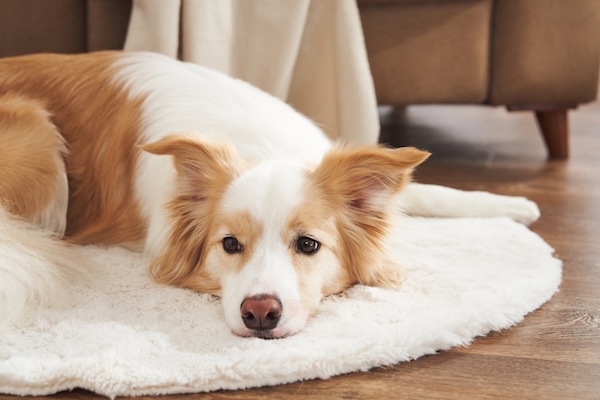
Once your dog is consistently going to their place on cue, it’s time to build the behavior you want to see while they’re on their mat. Ideally, this would be your dog lying down, since place training often involves your dog staying in one spot for a longer amount of time.
Here’s how to build this step:
- Stand beside the mat and say your place cue.
- Click/mark and reward your dog when they’re on the mat.
- Once on the mat, ask your dog to lie down, or lure them into the position. Click/mark once they’ve laid down and give them a treat.
- Once your dog has laid down and eaten treats, say your release word, and toss a treat away from the mat.
- Practice this step until your dog consistently goes to their place on cue and lies down automatically.
Pro-tip: To work on having your dog lie down without being cued or lured, say your place cue and wait for them to get on the mat and offer you a down. Once they do, mark the behavior and reward heavily.
Anna-av via iStock
Step 4: Build duration
>Now that your dog is consistently going to their mat and lying down, it’s time to build duration. Here’s how:
- Stand by the mat and say your place cue.
- Wait until your dog has gotten on the mat and laid down, then click/mark reward.
- While they’re still lying down, click and reward again.
- Continue to click and give your dog a treat for every second they’re lying down for five continuous seconds.
- Give the release cue and toss a treat/toy away from the mat.
- Let your dog move around a bit before starting a new session, slowly building the time they spend on the mat.
Pro-tip: You’ll also want to vary how frequently you’re giving treats to build duration, eventually rewarding once every 5 seconds, then 10 seconds, and so on.
Step 5: Work on distance
Along with duration, you’ll also want to work on having your dog stay on the mat while you move away from it. To do this:
- Stand by the mat and say your place cue.
- Wait until your dog has gotten on the mat and laid down, then click/mark reward.
- Take one step away from the mat, then mark and reward.
- Say your release cue and toss a treat away from the mat.
- Continue practicing adding more distance. Take two steps back, then three, slowly building your distance at a rate your dog can still stay successfully lying down on the mat.
Pro-tip: Practice cueing your dog to their place from varying distances. Start close to their mat, then a little farther with each successful repetition.
Step 6: Add distractions
Now, it’s time to test the behavior with distractions that could make your dog move. This stage helps your dog realize that regardless of where you are or what’s in front of them, they need to stay in their place. To work on distractions, you could add in the following while your dog is on the mat:
- Have another family member walk by
- Ring the doorbell or knock on the front
- Play sounds of dogs barking
- Have your dog go to their place while you’re on a work call
- Have a friend knock on the front door and come inside
Pro-tip: Start with something easy and gradually work your way up to more challenging distractions. Think about what you might encounter in your daily life and when you’d want your dog to stay in a “place,” and start building in training practice from there.

ivanoel28 via iStock
Benefits of Place Training for Dogs and People
Once your dog is confident with this cue, you can extend it to other designated places inside and outside of your home. Think of “place” as a portable safe zone that tells your dog where they should be in that exact moment.
Here are just some of the scenarios where “place” can be used at home:
- When you’re coming home and need to leave the door open
- Keeping dogs that love to jump grounded
- Keeping dogs off the couch when you have visitors
- Protecting people (particularly kids and elderly relatives) from canine hyperactivity and overexcitement
- Diverting over-enthusiastic doorbell reactions
- Keeping dogs that love to counter surf out of the kitchen during dinner preparations
- Getting your dog to sit still for photos
- Managing a household with multiple dogs
- Giving your dog a designated spot to calm down instead of getting the zoomies
And when out and about:
- Keeping your dog safe and stationery in busy places like campsites and cafes
- Giving your dog somewhere to sit during family picnics
- Creating a safe and comforting spot in hotels
- Meeting other people out hiking on trails
- Giving your dog somewhere familiar to sit during visits to the veterinarian
Troubleshooting Tips
While many dogs can learn place training relatively quickly, it can take weeks to months to build longer duration and consistency in performing the cue. Here are some expert troubleshooting tips to get your dog’s place on point.
Your dog is too excited and won’t settle
Giving your dog a “place” isn’t an instant fix for getting them to calm down. You have to gradually build the association with downtime. To help them out, take your dog for a long walk, run, or play session and get their energy out before you start your training sessions.
Your dog doesn’t stay in their place long enough
Make sure you’re gradually building your dog’s duration on the mat and your distance away from it, all while slowly adding in distractions. “Moving too fast is easily the biggest hurdle,” says Weber. “People forget that distance is a massive difficulty spike for a dog.”
One way to help anchor your dog to their spot is to give a long-lasting chew or stuffed KONG during “place” time.
Your dog is taking too long to learn the process
Dogs are individuals, and some might take longer to learn certain behaviors than others. If you’re feeling frustrated during training, take a breather and do something fun with your dog, and return to training when you’re both feeling fresh.
If you’re still at a standstill, reach out to a professional, as their guidance can help you get back on track with your training. To find a professional trainer near you, learn how dog training works on Rover.