- Not a substitute for professional veterinary help.
There’s a time and a place for everything, including a time for your dog to play enthusiastically and a time for them to relax. But relaxing doesn’t come naturally for every dog. That’s where a “settle” cue can come in handy.
“Rather than viewing ‘settle’ as an obedience behavior, we encourage guardians to think of it as an emotional regulation skill,” says Lisa Large, a certified dog trainer, behavior consultant, and co-founder of Thrive Canine Services. “It’s less about stopping behavior and more about supporting well-being. The goal is helping dogs learn how to relax, decompress, and recover from stimulation.”

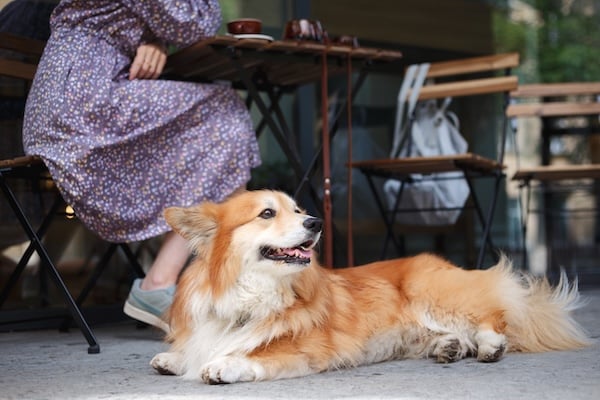
Large adds that modern dogs are often expected to transition between highly stimulating environments (like the dog park, coffee shop patios, and outdoor events) and calm household life with very little support. “Settling teaches dogs how to regulate their arousal levels and find calm in a variety of situations,” she notes.
Read on to discover how to help your dog settle on their own and build their self-regulating skills.
Pro-tip: Training a dog to relax on their own is just one of the many foundational skills to teach your new pup. To learn more about what to include in your training plan, reach out to a dog trainer near you.
Settle vs. Place
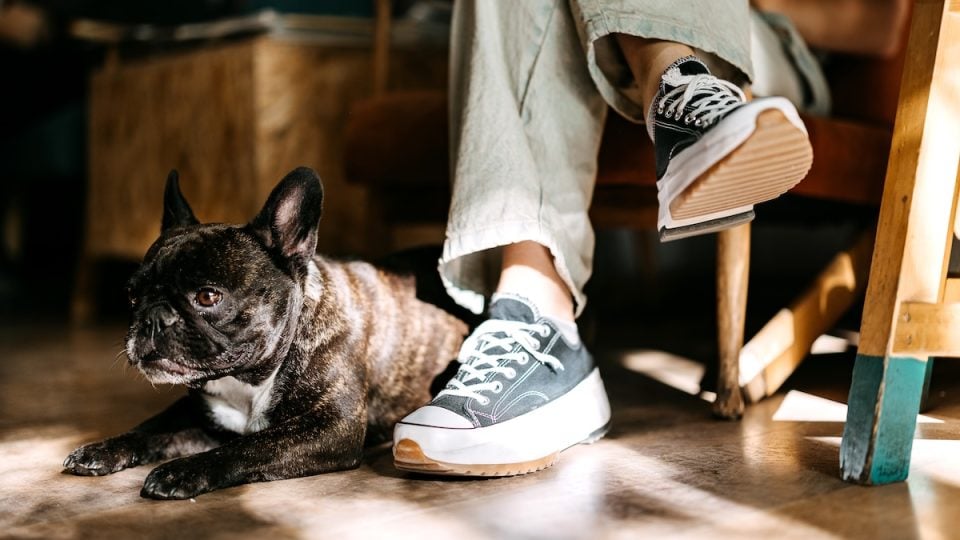
Unlike place training—which involves cueing your dog to a particular spot, like their bed or crate, until you’ve released them—training your dog to settle teaches them to relax when you relax. It uses context clues, like sitting down to read or working at your desk, to signal that it’s time to settle down.
Ultimately, Large explains, the goal isn’t to make your dog lie down on command. Instead, it’s to give your dog the tools they need to self-regulate and relax on their own.
One way to help them do this is by using a specific mat, rug, or towel that only appears for your training sessions. When this mat comes out, no matter where it’s placed, it helps signal that it’s time to relax.
“A mat develops meaning through repetition and association,” says Large. “Over time, it can become a predictor of relaxation, much like a person’s bed signals that it’s time to sleep or unwind at the end of the day.”
How To Teach a Dog To Settle on a Mat
With your mat and plenty of tasty treats, here’s how to teach your dog to settle in six simple steps.
- Step 1: Put the mat down where you want your dog to practice settling, like by the sofa or next to your desk. Scatter a few treats across the mat.
- Step 2: Get your dog and guide them to the mat. Use a leash if they need help staying close by, especially if they’re prone to wandering off.
- Step 3: As your dog approaches the mat to eat the treats, reward them again by putting even more treats down when they place all four of their paws on the mat.
- Step 4: Continue to reward them for spending time on the mat.
- Step 5: Keep the time short in the beginning, about 30 seconds. End each session by saying “all done” and walking away from the mat.
- Step 6: After your training sessions end, pick up the mat and put it away. That way, your dog begins to associate the mat with good things (and eventually settling).
Build duration
As you practice more repetitions, begin to extend the time your dog spends on the mat. Reward heavily for any signs of relaxation, including:
- Sniffing the mat
- Keeping their head down
- Sitting
- Lying down
- Shifting their hips
- Sighing, yawning, taking a deep breath
- Turning their body or looking away from you
You’ll also want your body language to be disengaged from your dog so they begin to understand that when you’re occupied or relaxing, that’s a cue for them to settle.
Practice in different locations
Move your mat and practice settling in various situations and rooms throughout the house. Think of all the times and places you’d like your dog to be able to relax and start working on your training there.
For instance, if you’d like your dog to relax calmly while you cook dinner, place the mat outside your kitchen and train there. You can also take the mat outside your house and practice settling in your yard and out in public (at the park, at your favorite cafe, etc.).
“A dog that can settle is often better equipped to handle visitors, restaurant patios, sporting events, veterinary appointments, family gatherings, and everyday life in general,” notes Large.
Fade out treats and the mat
As your dog progresses and is able to relax and spend more time on the mat, you can start reducing your rate of reinforcement (aka the amount of treats you deliver in a set amount of time).
To fade out the mat, practice all the steps above, just without the mat, so they start generalizing the progression of relaxation without it.
azgek via iStock
Training Tips
As with any new skill, teaching your dog to settle on their own takes time and patience. Here are some tips to help you and your dog be successful:
- Ensure you’ve met your dog’s needs. “A dog that is overtired, under-exercised, overstimulated, anxious, or frustrated will naturally find settling more difficult,” explains Large. “Before we ask a dog to settle, we should first ask whether we’ve given them appropriate opportunities to move, explore, sniff, forage, and engage with their environment.”
- Use lots of small, tasty treats. You’ll want to find a nice balance between treats your dog loves, but that won’t get them too excited or riled up, where they can’t relax.
- Start in a calm, quiet environment. When you first start training, pick a spot with minimal distractions where your dog already feels relaxed and safe.
- Reinforce relaxed behaviors throughout the day. Large encourages pet parents to reward any calm behaviors they see their dog exhibit unprompted, including soft body language, deep breaths, lying down, or disengaging from the environment.
- Gradually introduce more distractions and new environments. Practice settling when you have guests over, or take your mat training outside the dog park. Consider adding the Relaxation Protocol to your training to help teach your dog to relax in a variety of distractions.
Keep calm and carry on (with training)
Don’t give up if your dog takes more time or needs extra support. Often, the dogs who need added help relaxing—like high-energy breeds, young pups, or dogs who are easily overstimulated—will benefit the most from learning how to self-regulate.
“Rather than expressing excitement, frustration, or stress through jumping, pacing, barking, or mouthing, they learn that calm behavior is both safe and rewarding,” Large explains. While it may take a bit more time, it will be well worth it for your dog in the long run!