
- Not a substitute for professional veterinary help.
Does your new cat treat you more like a roommate than a family member? Whether you’re a first-time cat parent, fostering a new kitty, or trying to make friends with a friend or partner’s cat, you’ll need to win a cat’s trust before you can bond.

“Cats express emotions and affection differently than dogs and humans,” says Dr. Ruth MacPete, veterinarian and author of the Lisette the Vet children’s book series.
It’s common for cats to need more time when warming up to someone new. If you need help starting on the right paw, here are vet-approved tips on bonding with cats—plus tips to help when cats seem determined to keep their distance!
Help Your Cat Feel Safe
Cats tend to sort people into three different categories, says Linda Hall, co-founder of Cat Behavior Alliance and a certified cat behaviorist. “You are a predator—you’re going to eat me. You’re prey—I’m going to eat you. You’re part of my social structure, my family.”
These steps can help your cat feel safe and let them know you belong to their social structure.
Choose a home base
When bringing a cat home for the first time, Dr. MacPete says it’s best not to give them free run of the whole space right away. “Being let loose in a big house can be overwhelming.”
Instead, choose one room, like a bedroom or bathroom, as a spot to let them settle in. Choosing a smaller space also means your cat will know where how to find their essentials, like food and litter, right away. This helps prevents any accidents that might happen if they can’t find the litter box.
Make it cozy
To help your cat to feel more at home in their new environment, make sure they have spaces to hide.
“Hiding is a major coping mechanism for stress in cats,” says Dr. Julie Liu, Elite Fear Free Certified Professional and cat-friendly veterinarian. That’s why it’s important to make sure they have multiple spaces for hiding, like cubbyholes, carriers, or cat furniture.
Lower your tone
Use a quiet voice when you talk to your cat, Dr. MacPete advises. Soft, sing-song tones can show you’re not a threat and won’t make scary sounds. In fact, some research has found cats are more responsive when their preferred humans use a “baby talk” voice.
Try calming pheromones
Pheromones are chemicals cats naturally produce to communicate with each other. You can buy synthetic pheromones that mimic the ones cats naturally release when they feel safe and happy. Try plugging in a diffuser in your safe room or spritzing your hands before visiting your kitty.
Let Your Cat Set the Pace
One of the easiest ways to help your cat feel safe is to let them take the lead with your interactions, especially if they’re a rescue or foster.
“Bad experiences with people can make cats (and anyone, for that matter) hesitant to trust people again,” Dr. MacPete says.
Sit in one place
When you first enter your cat’s space, don’t immediately seek them out.
“Try just hanging out near your cat while you read or use your phone,” Dr. MacPete suggests.
This makes interacting with you the cat’s choice, not something they’re forced into.
Sniffs before snuggles
Just because the cat approaches you, that doesn’t necessarily mean you have an all-clear to start petting them. It doesn’t automatically mean they want you to hold them, either.
“When you pick a cat up, you’ve just killed all of their defenses,” Hall says.
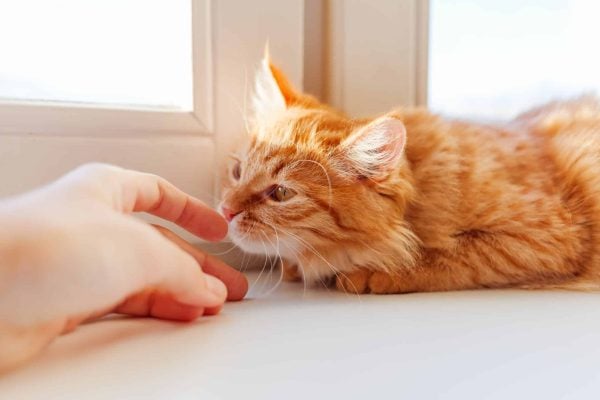
Instead, offer one of your fingers for the cat to sniff. If they start rubbing their nose or face against your finger, that’s your cue to try some light scratches!
Avoid ‘no touch’ areas
When a cat approaches for pets, concentrate on scratching around their head and areas like the cheeks, forehead, and under the chin. Petting the head is almost always a safe bet, since cats initiate affection head-first.
Once you start earning more trust, your cat might roll over and show you their tummy, but that doesn’t mean they want you to touch. The stomach, tail, and front and back legs are all vulnerable areas, and most cats prefer paws off!
Assess their body language
Keep an eye on your cat’s body language throughout your interactions.
If they have a relaxed posture with a raised tail and slow blinks, they’re most likely happy and enjoying themselves.
Twitching tails, laid-back ears, or pulling away are signs to offer more space.
Create Positive Associations
By this point, your cat should realize you’re not a threat and feel more comfortable hanging out near you. Now, you can slowly start winning them over by showing them it’s rewarding to spend time with you!
Use treats
“A little bribery never hurts,” Dr. MacPete says. When you’re visiting your cat in their safe room, start giving them treats to associate your presence with yummy food.
Squeeze tubes like Churu are almost always a hit, although some cats might prefer hard treats, like Greenies. It’s not a bad idea to keep both on hand until you know which type of treat your cat prefers!
Play with them
Beyond food and pets, playing with your cat can help you bond and become friends, Hall says. If they’re still skeptical about you getting too close, try a toy you can use from a distance, like a fishing pole-style wand or a laser pointer.
Be Consistent
Cats like predictable daily routines because it helps them feel in control of their environment, especially if they’ve just moved to a strange new house. Even small changes to their routine, like a change in their feeding schedule, can make cats act sick and stressed!
You don’t necessarily need to have things timed to the minute but it can help to keep the schedule roughly the same every day. For instance, you might make sure to give dinner between 5 and 6 p.m.—and if you run late, they’ll certainly let you know!
Tip: Try syncing their daily routine to yours. For example, after you get ready for work, have a quick play session before you head out the door. Before you sit down for dinner, serve your cat first. Before long, you might find that your cat is keeping you on schedule.

How Long Does It Take?
Every cat has their own timeline for opening up, which depends on their prior experiences with people.
Most cats typically adjust to their new surroundings within a few days, but it takes between one and three months for them to build a baseline of trust with new people, according to Cynthia Palmisano, a psychologist at Saybrook University and member of the school’s Animal Care, Research, and Education with Dignity (SACRED) group.
Some might take more or less time than that to feel safe and affectionate, depending on factors like:
- Previous experiences with people
- Temperament/personality
- Age (kittens often adjust to new situations faster)
- Household environment
- Whether there are other pets or people in the house
- Fear or anxiety
Signs You’re Building Trust
If your cat seems distant after a few months of you trying to win them over, that doesn’t mean you’re not making progress.
“Cats are much more reserved when it comes to showing affection,” Dr. MacPete explains. For example, you might think your cat merely tolerates you by sitting next to you on the couch instead of in your lap. In reality, if they sit with their back facing you, that’s actually a sign they trust you enough to let their guard down.
More signs your cat likes you include:
- Rubbing against your hands or legs
- Head bonks
- Trills and purring
- Slow blinks
- Grooming you
- Greeting you when you come home
- Following you between different rooms
- Bringing you toys or other “gifts”
- Sitting near you
- Sitting on you
What If My Cat Still Doesn’t Trust Me?
If it’s been more than a few months and your cat still doesn’t seem relaxed in their new home or comfortable with you, you might see behaviors like:
- Running away or hiding
- Growling or hissing
- Disinterest in play
- Refusing treats you offer
If your cat shows signs of stress, try taking them to the vet. They can double-check to make sure their behavior isn’t due to illness or pain. Your vet can also refer you to a pet behaviorist who can help you identify things that could be causing stress and give advice on solutions.
But sometimes, cats may just need a little extra time to open up, so be patient!