- Not a substitute for professional veterinary help.
Spinning is an entertaining party trick that most dogs pick up quickly—and best of all, it comes with worthwhile benefits. Not only does it provide a good mental and physical outlet for your pup, but it can also improve your dog’s balance and coordination. Plus, it comes in handy if you’re working on agility.
To do a spin correctly, a dog must make a full 360-degree turn while mostly staying in the same spot. Here’s how to teach them to do just that in a few simple steps.

Did you know? You can use tricks like spin to build foundational skills in your training plan. Find a trainer near you to help make your training sessions both functional and fun.
How To Teach Your Dog To Spin
Certified dog trick instructor Joe Nutkins of Dog Training for Essex and Suffolk explains five steps to teach your dog a spin:
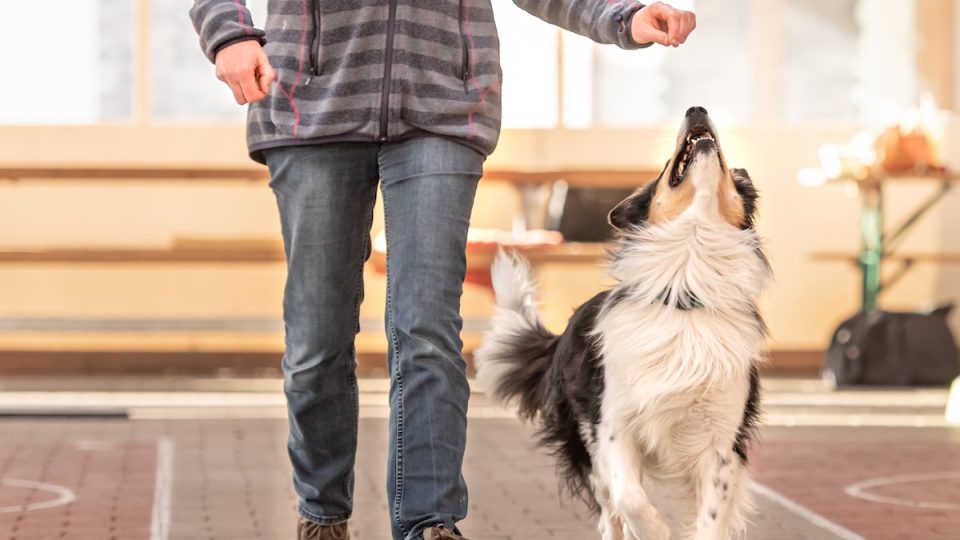
- Put a high-value treat or a favorite toy in front of your dog’s nose and slowly lure their head to one side. When your dog turns their head even a little bit, mark with a click or “yes!” and reward them.
- Once your dog consistently turns their head to the side, begin gradually moving the lure farther back toward their tail until they make a quarter turn, then a half turn, and finally the full 360-degree rotation. Make sure to mark and reward for each successful movement.
- When your dog can do a full 360-degree turn, ditch the treat or toy but make a circular movement with your hand for them to follow. Once your dog does the full spin, mark the behavior and reward them. Keep practicing the full turns with your hand motion until your dog consistently spins all the way around.
- Next, begin to add the verbal cue by saying the word before your hand signal. Mark the action and reward your dog when they complete the spin.
- Then you can start fading out the hand signal. To do this, make your hand motion smaller before saying the word “spin.” Eventually, try not to use a hand signal at all. Say the word “spin” and wait for your dog to respond, rewarding heavily when they complete the full turn. (If they don’t spin within 5 to 10 seconds, show them your hand signal instead of repeating your verbal cue. It may take some time to fade out.)
Adding direction
Just like people have a dominant hand, dogs often have a preferred side they like to spin. If you’d like your dog to be able to spin both left and right, you’ll need to first master a spin in their preferred direction before teaching them to spin the other way.
Using the same step-by-step process above, you can teach your dog to spin in either direction by giving a different verbal cue for each. You might call one way “spin” and the other “twirl,” or simply use “left” and “right.”
Just make sure to practice spinning both ways. “Do the spin in the new direction a couple of times to every one spin in the preferred way,” recommends Nutkins.
Benefits of Teaching a Spin
Teaching your dog to spin isn’t just a fun trick. There are benefits to learning this skill, too.
- Spins can improve your pet’s balance and coordination, helping enhance their performance in agility, sports, and everyday tasks.
- You can incorporate a spin into your heel position. Cueing a spin on walks can help your dog maintain focus around distractions. Plus, it adds a bit of a flourish to an otherwise straightforward obedience routine.
- Spins help a dog learn how to turn tightly for agility, which can be useful for learning more advanced skills, such as figure eights and leg weaves.
Spin vs. Circle
“A spin is where a dog turns around while staying in the same position and finishes when they face their owner again, while a circle is when a dog moves around an item or around their handler,” explains Nutkins.
To put it in human terms, a spin is like a ballet dancer performing a pirouette, while a circle is like a person walking along a circular path.
Troubleshooting Tips for Common Issues
If your dog’s not quite getting the hang of a spin, here are a few things to consider:
- Are you leaning over your pup too much and unintentionally scaring your dog? Though it can be tricky with short-legged pups, try to keep your body as upright as possible. That way, your dog doesn’t feel like you are looming over them.
- Is your dog jumping up instead of spinning? You’ll want to keep the lure at your dog’s nose level without bringing your hand up. “Holding the treat too high can encourage jumping on the back legs, which you don’t want,” explains Nutkins.
- Is your dog walking toward your hand instead of turning with it? In this case, you may be moving your hand signal too far away from your body. Try making your hand movement a little smaller and keeping it closer to you.
A spin is just one of many fun tricks to teach your dog. To reach out to a local dog trainer and create a customized trick training plan, learn more about how dog training works on Rover!