- Not a substitute for professional veterinary help.
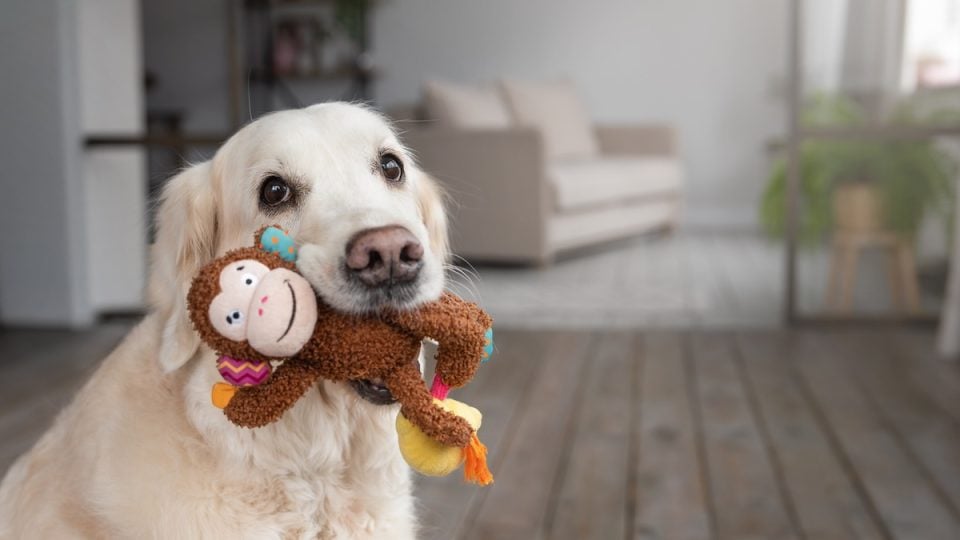
Want to teach your dog to hold something in their mouth? This trick can be a little difficult to master, but if you’re patient and have established good communication with your dog, it’s definitely achievable.
Besides helping with fun photo ops, “hold” is a useful cue for sport dogs who hunt, as well as dogs who do agility games, dock diving, and scent work. It’s also an essential skill for many service dogs.

“Teaching a reliable hold is a game-changer for accessibility, giving dogs a functional way to assist with daily physical tasks,” says Aubrey M. Weber, B.Ed., DBC, CPDT, CCFC, PNCC, a certified dog trainer on Rover. “Once a dog learns to confidently hold an object, you can easily transition that skill into practical behaviors like retrieving a dropped leash, picking up fallen objects like keys or phones, and even pulling straps to open doors.”
In this step-by-step guide, we explain how to teach your dog to hold something in their mouth, along with other tricks that require “shaping,” or breaking a skill down into small movements.
Choosing The Right Object
When teaching your dog to hold, start with something simple and safe. Pet parents can transfer this skill to anything, but some objects will be easier than others while your dog learns, including:
- Soft rubber toys that are designed for your dog’s mouth and likely already pique their interest.
- Rolled-up towels that are soft, easy to hold, and have a texture that is desirable for some dogs. They may also be better for teaching a hold if your dog is too distracted by a toy.
- Foam balls are also soft and easy to hold, and your dog may already like having them in their mouth, which can make training easier.
Natalya Gavrilova via iStock
Step by Step Training
“For a dog that doesn’t naturally pick things up, you want to shape the behavior by rewarding tiny baby steps,” says Weber. “You start by rewarding the dog just for looking at or sniffing the item, and then progress to marking any open-mouth contact. From there, you reward the exact moment they willingly take the object into their teeth, and finally, you delay the treat by just a split second to start building duration.”
Below, we’ll discuss how to do each step in more detail.
Step 1: Reward for any interaction
First, reward your dog for any interest in the object. To do this, you’ll need plenty of tasty treats and to follow these steps:
- Position your dog in front of you and show them the toy/object.
- Closely watch to see if your dog interacts with the item in any way. This could look like moving toward it, booping it, licking it, sniffing it, biting it, etc.
- As soon as your dog interacts with the object, click or mark with a “yes!” and reward them immediately.
Note: Use the same toy/object throughout your training until your dog reliably learns to hold on cue. After that, you’ll be able to transfer the behavior to other items.
Step 2: Work on gripping the object
Next, work toward getting your dog to grip the object in their mouth. To encourage this, look for more and more of the final behavior (i.e., putting their mouth on the object) before you mark and reward them. Some dogs might catch on quickly, while others may need extra help. If your dog falls into the latter category, here’s what you can do:
- Use a cylinder object—a dumbbell toy works great here!
- In your left hand, hold the toy very close to your dog’s mouth.
- In your right hand, hold a high-value treat in front of the toy, so your dog will have to mouth it in order to get to the treat.
- Once your dog mouths the toy, immediately mark the behavior, remove the toy from their mouth, and reward with the treat .
Note: It may take a while but wait until your dog mouths the toy to get to the treat. You can even gently insert the toy into their mouth (using your finger if need be), making sure not to force/jam it in.
Step 3: Add a verbal cue
Once your dog can reliably put the toy/object in their mouth, it’s time to add your cue—like “hold” or “take.” To do this:
- Say your cue.
- Move the object toward your dog.
- Mark as soon as they put the object in their mouth.
- Take away the dumbbell before they have a chance to spit it out.
- Reward with a treat.
Note: Make sure to move the toy/object away from your dog’s face after each repetition. This will help them learn that the cue is part of the equation.
Step 4: Add duration
The next step is to slowly increase the time your dog holds the object in their mouth. To do this:
- Say your cue.
- Move the object to your dog so they can put it in their mouth.
- Delay your marker by a nanosecond after your dog has the item in their mouth.
- Take away the dumbbell before they have a chance to spit it out.
- Reward with a treat.
- Keep adding more and more time (at small increments) between your cue and your marker word.
Note: If needed, you can gently put your hand below your dog’s chin before giving them the item to help them with the hold. Take your time and support your dog as needed. Adding duration is hard! Be patient and try not to rush your dog.
Step 5: Add a release
Lastly, start incorporating a verbal cue to signal to your dog that they can release the object. If your dog knows a “drop it” cue, then you can use it as your release. If they don’t, start saying your release word when you swap out the item with a treat.
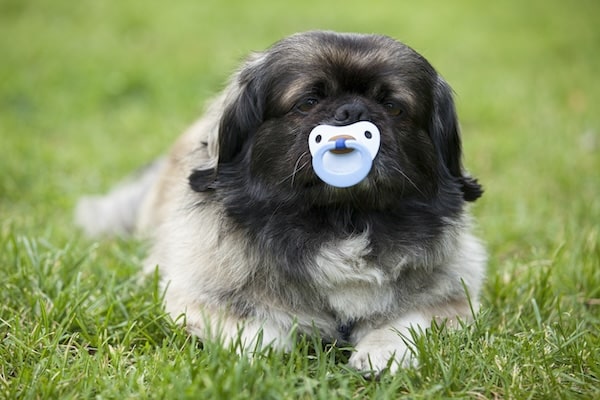
Teaching Your Dog To Hold a Pacifier
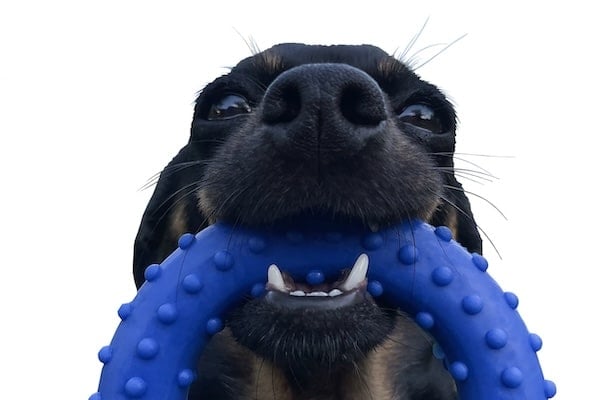
Once your dog can recognize the verbal cue for “hold,” you can start changing up the objects. Pacifiers are a silly and popular pick, since they lend themselves to photos (and are wildly popular on social media). To join in on the trend, you’ll follow the same steps above with the following notes:
- Give the pacifier to your dog with the tip facing inward.
- Mark and reward when your dog is holding the pacifier correctly.
- Really work on building enough duration so you have enough time to snap a picture.
TerryJ via iStock
Tips and Tricks
A “hold” can be a tricky skill to teach. Here are a few ways to help set you and your dog up for success in your training.
Slow down
“The biggest mistake is moving too fast and expecting a full grip right away, which usually just confuses or frustrates the dog,” says Weber. If your dog is struggling, take a step or two back until you find where your dog is successful and work from there.
Try food
If your dog doesn’t show interest in holding toys or other objects, try a bone or long-lasting chew instead. Just make sure you have something equally as valuable to swap out when working on the steps above.
Keep things positive
Be sure to reward and praise your dog for exhibiting steps toward the desired “hold” behavior, even if they don’t get it right away. If you notice that your dog is getting frustrated, pause training and engage with something else that your dog enjoys. You can always pick training back up tomorrow when you’re both in a better mindset!
Perfect your timing
Precision is incredibly important when shaping a hold. You want to mark each moment your dog slightly progresses and reward heavily. That’s where a professional can help. “A trainer knows exactly how to read the split-second moments a dog shows interest, ensuring you mark and reward the behavior at the perfect time before frustration sets in,” notes Weber.
For help with your timing and other troubleshooting details, find a dog trainer near you to level up your training game!