- Not a substitute for professional veterinary help.
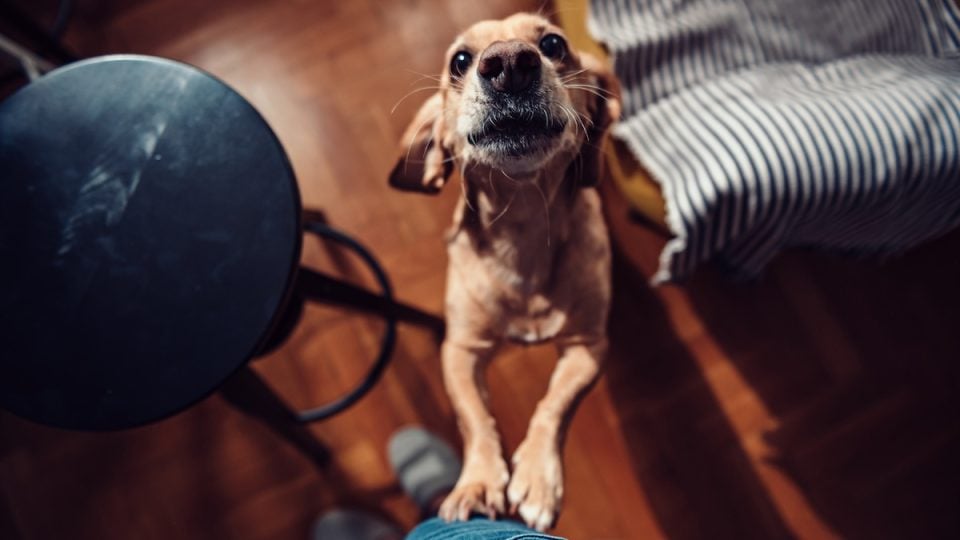
Jumping to greet people is a natural instinct for dogs, often driven by excitement—and it’s an almost guaranteed way to get a human’s attention. But while an enthusiastic greeting can be heartwarming for pet parents, it can be a problem if that’s your dog’s default way of saying hi to newcomers.
Early training can help, as Tiffany Song, CCPDT-KA, VSA-CDT and trainer on Rover, explains. “It is best to address this during puppyhood so we do not have to deal with a 90-pound dog jumping in a few months,” she says. But it’s never too late to get started.

Here’s how to redirect, reward alternate behaviors, and manage your dog’s enthusiasm while you train.
Why Dogs Jump
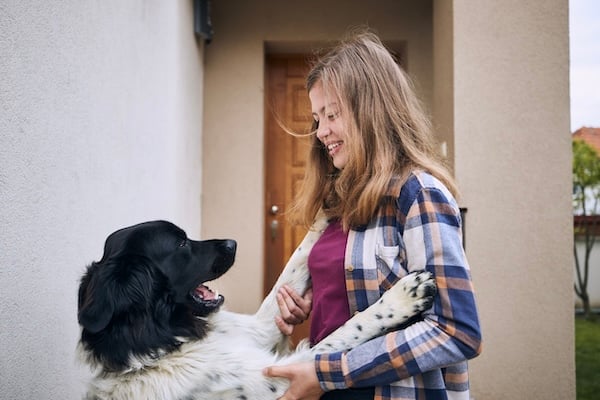
In dog communication, face-to-face is the proper way to say hello. Faces are the place to get key information, like eye, mouth, and scent cues. So jumping to get a closer look and introduce themselves is natural—especially if they’re hyped.
“Dogs typically jump on people out of excitement, overarousal, and sometimes out of nervousness,” explains Song.
It’s also easy for humans to inadvertently reinforce jumping as a greeting behavior. Even if you’re frantically yelling “down,” that’s engagement—which counts as a win in your dog’s book.
Step 1: Don’t Reward Jumping
Your dog is smart: as long as jumping works to get attention, they’ll keep doing it. Your first job is to make sure your whole household—and newcomers—know how not to reward or reinforce jumping.
When your dog’s paws leave the ground, the subject of their attentions should become a tree. Cross your arms and turn away, without pushing, talking, or making eye contact.
Once your dog’s paws are on the floor, turn around and immediately offer the engagement your dog craves. If they jump up again, go back to being a tree. Repeat as necessary.
Pro tip: “Being a tree” sounds easy enough in principle, but in practice it can be hard to stay still if an 80-pound Labrador is trying to climb your legs. If you’re struggling, consider stepping behind a barrier like a baby gate as your form of disengagement.
Chalabala via iStock
Step 2: Teach an Incompatible Behavior
One of the best ways to train your dog to greet people without jumping is to teach them a cue that’s incompatible with launching into the air—like a “sit,” a “down,” or a “go to spot” cue.
It’s easiest to teach these cues first in a calm moment. Once your dog has them down, you can start adding difficulty: the excitement of your arrival or the appearance of a guest.
When a newcomer appears, before your dog can jump, give the cue—and reward the correct behavior generously.
Some tips that can help:
- Use your highest-value treats or rewards. You want the treat to be more exciting than prospect of jumping on the newcomer.
- Start with a low level of distraction. If your dog is struggling to respond to cues in the heat of the moment, make it easier. That might mean adding distance, trying with a less exciting person, or switching practice time to a calmer hour.
- Increase exercise. If you know you’ve got an exciting guest coming, let your dog burn off some energy with a long walk first.
- Get a practice buddy. Need someone to practice with? Try a sitter on Rover, who can schedule a drop-in visit to knock on your door or rehearse greetings.
Management Tips
Ideally, a good cue will replace jumping as your dog’s default greeting—but until your dog has some training under their belt, you’ll need a plan.
One of the most effective ways to stop a dog from jumping on people is to use the “redirect and reward” method.
Prepare a container of treats or a basket of toys—whichever motivates your pup most—at your front door. Before a guest enters, toss the treats or toys away from the door to redirect your dog’s attention and provide a simultaneous reward for not jumping when a guest walks in.
Pro tip: Want maximum distraction power? Try setting out a lick mat with dog-safe peanut butter or yogurt before guests arrive.
Other good management strategies include:
- Don’t make a big deal out of greetings. Keep your comings and goings as mellow as possible so your dog doesn’t practice jumping.
- Say hi at dog level. Consider getting down on your dog’s level to greet them so they don’t rehearse jumping behaviors.
- Be consistent. Make sure the whole household is on board—if your dog is still finding jumping rewarding, it will be that much harder to convince them to stop.
- Don’t punish jumping. If jumping happens, don’t yell or discipline your dog. Just turn away or remove yourself until your dog has four on the floor again.
Can a Professional Trainer Help?
Jumping can be a hard behavior to work on, especially if it’s an ingrained habit. Consulting a professional trainer can help.
For pet parents struggling with the training, set up is often key. “Ways to help bring the dog’s brain down prior to greeting makes a big difference that the normal pet parent may not know how to do,” Song explains.
She adds that jumping may also coincide with other overexcited behaviors like barking and mouthiness—both of which a professional can help with.
Need a training plan to combat jumping? Try reaching out to a trainer on Rover, who can set you and your pup up for successful greetings.