- This post contains affiliate links. Read more here.
- This article has been reviewed by a pet health professional. It is not a substitute for professional veterinary advice.
Puppies have very specific nutritional needs: a balanced diet with the right amounts of protein, fat, and calcium, along with enough calories to fuel their antics.
The pet food market has a huge range of options, with choices for different diets, sizes, and palates. But this can also make choosing the right puppy food overwhelming, especially for first-time puppy parents.

We’ve combed through the scores of puppy foods, surfacing 11 products that comply with AAFCO guidelines to meet different puppy needs. Need more information? Check out our explainer on a puppy’s nutritional needs, the different kinds of dog food, and how much to feed. Or read on for our top picks of the best on the market.
Finally, remember to run your selection by your vet, who can help determine whether your choice is a good fit for your particular pup’s needs.
How We Chose the Top Puppy Foods
It can be difficult to navigate all the different marketing claims when choosing the healthiest food for your puppy. Different dogs have different nutritional needs. But this often gets lost in a market full of big claims. That’s why we conducted in-depth research on our own.
We hand-tested many of these products ourselves while also interviewing veterinary experts, diving deep into clinical studies, and commissioning our own internal research into the world of dog food. Additionally, we selected widely available commercial brands that meet AAFCO nutritional requirements.
By using concrete numbers and statistics, we hope to empower dog guardians to feel confident in choosing the best dog food for their puppy.
Top Brand Recommendations
In terms of quality and science-backed nutrition, five brands stand out as the “gold standards” for puppy food. These include:
- Hill’s Science Diet
- Purina
- Royal Canin
- Iams
- Eukanuba
Each of these brands develops its formulas alongside a team of veterinarians, scientists, and board-certified veterinary nutritionists. Currently, they are the only brands that meet all of the rigorous standards set by the World Small Animal Veterinary Association (WSAVA).
Note that WSAVA, like AAFCO, does not “approve” or endorse brands but rather sets guidelines on manufacturing practices, food trials, and quality control measures. As the industry evolves, more brands may rise to meet these standards.
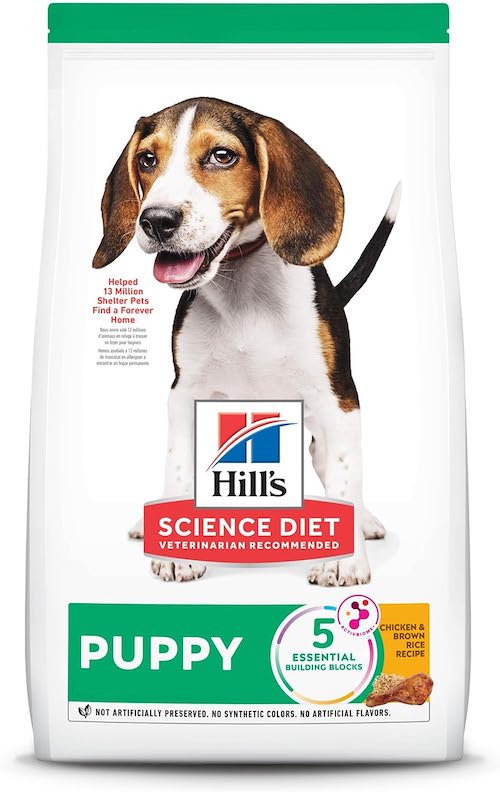
Best Dry Food: Hill’s Science Diet Dry Puppy Food
- Recommended age: up to 12 months
- Recommended breed size: Small, medium, and large breeds
- Size: 4.5-lb bag, 15.5-lb, bag 27.5-lb bag
- Flavor: Chicken & brown rice
Find on Chewy Find on Amazon Find on Petco Find on PetSmart Find on Walmart
Dry puppy food is convenient to serve and easy to store—and it may have benefits for your puppy’s dental health. Nutritionally, this dry Science Diet formula is a real winner. Hill’s is a well-regarded brand in the pet food industry, employing hundreds of veterinarians, food scientists, and nutritionists to develop their recipes. Every recipe is taste-tested by pets at the company’s Pet Nutrition Center in Kansas, and they all meet all the guidelines set forth by WSAVA as well as AAFCO.
This dry puppy food features a kibble size that’s suitable for both small and large puppies (4 mm x 10 mm). It’s also nutritionally robust, with clinically proven antioxidants for a healthy immune system and fish oil for brain and eye development. Plus, it includes prebiotic fibers to support your puppy’s digestive system.
| Calorie/cup | Protein | Fat | Fiber |
| 393 kcal/cup | 27.8% | 19 | 2.5% |
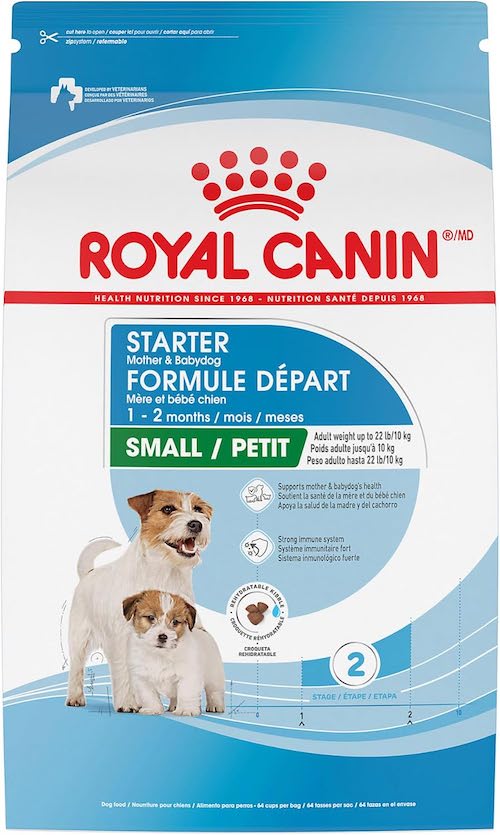
Best Kibble for Newborn Puppies: Royal Canin Starter Mother & Babydog Dry Food
- Recommended age: 3-8 weeks
- Size: 2.5-lb bag, 14-lb bag
- Flavor: Chicken
Find on Chewy Find on Amazon Find on Petco Find on PetSmart
For the first few weeks, newborn puppies are nourished entirely by their mother’s milk (or a commercial puppy formula). At around 3 to 4 weeks, you can start introducing puppy food. Formulated for pups under two months, this Royal Canin recipe features tiny kibble pieces for the tiniest of puppy mouths. It has everything a growing newborn needs: antioxidants for a strong immune system, prebiotics for a healthy gut, and omega fatty acids for brain development.
At first, you’ll want to add water to moisten and soften this kibble. Once puppies reach 4-7 weeks, you can serve this food without water. For those who want to feed both wet and dry food, the brand also carries a mousse for newborns.
| Calorie/cup | Protein | Fat | Fiber |
| 387 kcal/cup | 28% | 20% | 3.6% |
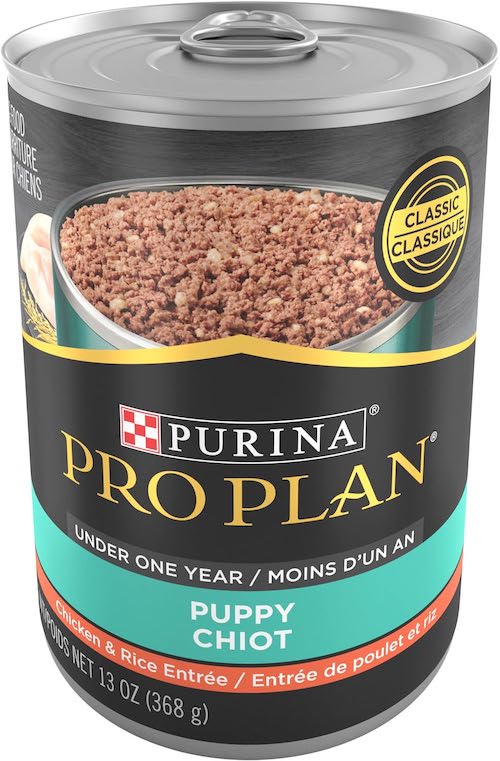
Best Wet Food: Purina Pro Plan Development Chicken and Rice Entree
- Recommended age: up to 1 year for small-medium dogs; up to 2 years for large breeds
- Recommended breed size: Small, medium, and large breeds
- Size: 13 oz can
- Flavors: Chicken & rice, Turkey
Find on Chewy Find on Amazon Find on Petco Find on Walmart
Whether you’re serving it exclusively or using it as a complement to a dry diet, wet puppy food makes a good choice for many dogs. It contains higher moisture levels, keeping your puppy hydrated, and it generally contains fewer carbohydrates than dry food (though it’s worth noting that carbs aren’t bad—high-quality carbs are an important part of a dog’s diet).
Purina’s recipes are developed by a team made up of scientists, behaviorists, nutritionists, and veterinarians, and the company follows AAFCO’s recommendation to conduct feeding trials. The brand’s Pro Plan line is hugely popular with pet parents and their pups for its taste and nutrition.
This chicken and rice pate is a good texture for freezing in KONGs or spreading on lick mats. It contains DHA to support brain and vision development. And it has a stronger smell, which helps entice puppies to eat it. It’s also slightly more affordable than other similarly rated brands.
| Calories | Protein | Fat | Fiber |
| 437 kcal/can | 10% | 7% | 1.5% |
Best for Large Breed Puppies: Royal Canin Large Puppy Dry Food
- Recommended age: 2-15 months
- Recommended breed size: Large breed with an adult target weight 55-99 lbs
- Size: 4-lb bag, 17-lb bag, 30-lb bag, 40-lb bag
- Flavor: Chicken
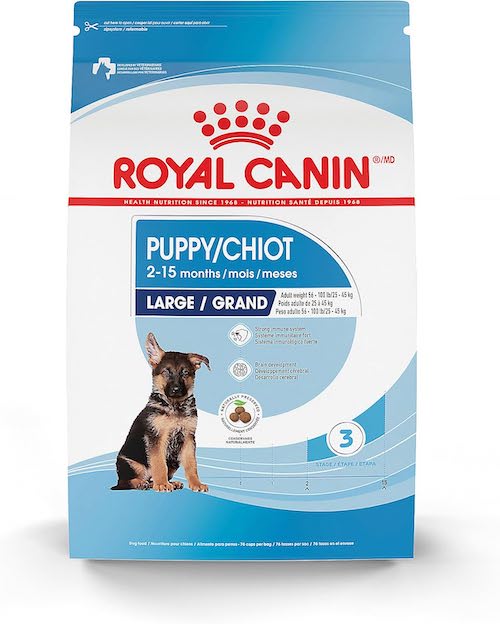
Like every Royal Canin recipe, this large breed puppy kibble was developed by veterinarians and nutritionists and tested at one of the company’s research facilities. To prevent excess weight gain, it contains fewer calories than our pick for small breeds. It also contains glucosamine and chondroitin sulfate for healthy joint development and a proportionately larger kibble size.
High-fiber ingredients like beet pulp and psyllium husk help keep your large breed puppy regular. For the largest of puppies, the brand also carries a Giant Breed Puppy Food.
| Calorie/cup | Protein | Fat | Fiber |
| 349 kcal/cup | 28% | 14% | 3.7% |
Best for Small Breed Puppies: Purina Pro Plan Small Breed Formula
- Recommended age: up to one year
- Recommended breed size: Small breed with target adult weight 3-20 lbs
- Size: 6-lb bag, 18-lb bag
- Flavor: Chicken & rice

Find on Chewy Find on Amazon Find on Petco Find on PetSmart Find on Walmart
Small breed puppies have fast metabolisms, which means they require energy-dense food. In fact, they need more calories per pound of body weight than large-breed puppies.
This Purina Pro Plan recipe is formulated for puppies with a projected adult weight of less than 20 pounds. It contains considerably more calories per cup than our large-breed recommendation (482 kcal versus 386). And protein levels are generous (37.5% on a dry matter basis), which helps energize small puppies who are highly active.
For smaller breeds, kibble size matters, too. This disc-shaped kibble measures ¼” in diameter, so it’s easier and safer for tiny puppies to chew. Many pet parents report improvements in their pup’s digestion with this food, citing solid stools and the resolution of tummy troubles. In addition, this formula contains 2% omega-6 fatty acids for healthy skin and coat, omega-rich fish oil for brain and vision development, and probiotics for digestive and immune health.
For the tiniest of pups, the brand also carries a toy breed puppy formula.
| Calorie/cup | Protein | Fat | Fiber |
| 482 kcal/cup | 33% | 20% | 3.0% |
Best for Medium Breed Puppies: Eukanuba Medium Breed Puppy Food
- Recommended age: up to 12 months
- Recommended breed size: Medium breed, with target adult weight 24-55 lbs
- Size: 4.5-lb bag, 16-lb bag, 30-lb bag
- Flavor: Chicken
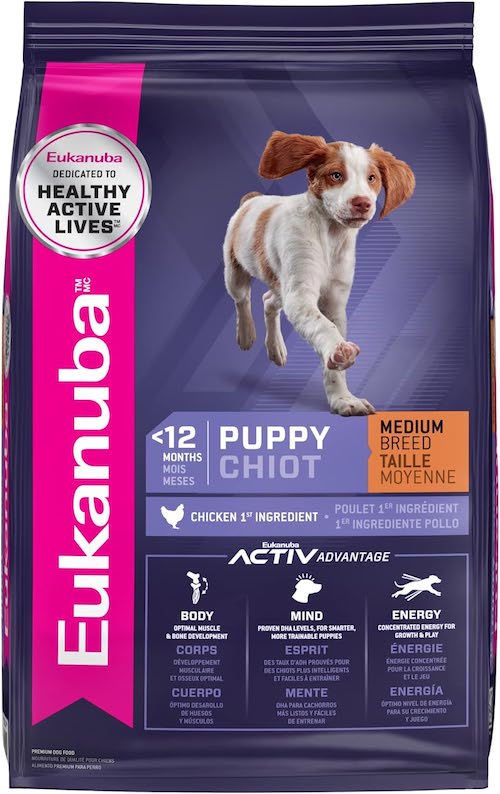
Finding a size-specific food for medium-breed puppies is notably trickier, as most brands only carry recipes for either large or small breeds. Eukanuba is one of the few exceptions, offering this formula for puppies expected to reach 24 to 55 pounds at maturity.
According to the brand, they were the first to include beet pulp and prebiotics for digestion—two key ingredients you’ll find here. This recipe also features an antioxidant blend for immune support and precise levels of DHA for your puppy’s growing mind.
| Calorie/cup | Protein | Fat | Fiber |
| 431 kcal/cup | 29% | 18% | 3.4% |
Best for Food Allergies: Natural Balance L.I.D. Salmon Recipe
- Recommended age: up to one year
- Recommended breed size: Small, medium, and large breeds
- Size: 4-lb bag, 12-lb bag, 24-lb bag
- Flavors: lamb & brown rice, salmon & brown rice

Find on Chewy Find on Amazon Find on Petco Find on Walmart
While food allergies are relatively rare in dogs, some puppies will develop allergies to certain proteins, most notably beef and chicken. In these cases, your veterinarian may recommend switching to a new protein.
All Natural Balance L.I.D. foods are made with a single-source protein, limited carbohydrates, and a pared-down list of ingredients. This chicken-free puppy formula features omega-rich salmon and whole-grain brown rice as a source of fiber.
The calcium content and caloric density make it suitable for both small and large breed puppies. And the puppy-sized kibble is shaped for smaller jaws (similar to a Cheerio). If fish doesn’t tickle your puppy’s palate, the brand also carries a lamb recipe for puppies.
| Calorie/cup | Protein | Fat | Fiber |
| 385 kcal/cup | 24% | 12% | 4.5% |
Most Transparent Ingredient Sourcing: Open Farm Ancient Grains Dry Puppy Food
- Recommended age: up to one year
- Recommended breed size: Small, medium, and large breeds
- Size: 4-lb bag, 22-lb bag
- Flavor: Chicken, salmon, & ancient grains
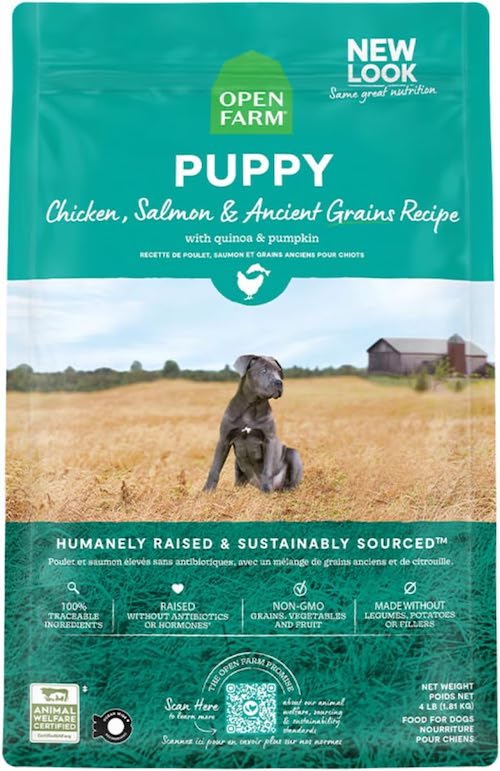
For pet parents who want to know where the ingredients in their puppy’s food come from, Open Farm is a top contender. Our Rover testers were impressed with how easy the company makes it for consumers to trace dog food ingredients. On the Open Farm website, you can enter the lot code found on your food’s package to learn the source of each ingredient. What’s more, the brand lays out specific ethical standards for its pork, chicken, and fish ingredients.
This grain-inclusive formula includes a blend of wholesome grains, including millet, brown rice, and steel-cut oats. Wild-caught salmon brings DHA to the table. Even picky eaters can get on board with this puppy kibble.
| Calories | Protein | Fat | Fiber |
| 425 kcal/cup | 26% | 16% | 4.5% |
Best Budget Option: IAMS ProActive Health Smart Puppy Food
- Recommended age: Up to one year
- Recommended breed size: Small to medium breeds
- Size: 7-lb bag, 15-lb bag
- Flavor: Chicken

Find on Chewy Find on Amazon Find on PetSmart Find on Walmart
Dog food can be expensive—but budget food doesn’t have to be low-quality. IAMS is one brand that manages to balance quality with affordability. The company follows both AAFCO and WSAVA nutritional guidelines—and it does so at only $1.99/pound.
This puppy formula includes omega-3 DHA to promote healthy brain development. And it’s enriched with antioxidants for your pup’s developing immune system. They also carry formulas for small and large breed puppies. On the downside, this food is only sold in 7- and 15-pound bags.
| Calorie/cup | Protein | Fat | Fiber |
| 397 kcal/cup | 29% | 17.5% | 4% |
Do Puppies Need Toppers and Supplements?
Puppies can receive all the nutrients they need from AAFCO-compliant puppy food, so generally, toppers aren’t necessary. But if your puppy isn’t interested in their food, a topper might be able to help.
A disinterest in food isn’t uncommon—your puppy might just dislike the food’s taste or texture. Maybe they’re stressed by a change in your household’s routine. Often, puppies are just so busy exploring and playing that they don’t even notice they’re hungry! Moistening kibble with bone broth or another dog-safe meal topper can encourage picky puppies to eat. And many offer a boost of nutrients to support your pup’s development.
While toppers can make food more appealing and provide hydration, take care not to overdo it. If a meal topper isn’t “nutritionally complete and balanced,” then it counts as a treat—and treats should make up no more than 10% of your puppy’s daily caloric intake. This is especially important to remember if you’re using a lot of treats for training.