- Not a substitute for professional veterinary help.
A dog who can offer a high five on cue looks impressive—but you might be surprised how easy this sweet trick is to learn. Besides being a fun activity to do together, teaching “high five” is a great way to get your pup used to having their paws touched or to greet guests. Plus, it lays the groundwork for even more advanced tricks to work your dog’s brain, like waving or saluting.
While not essential prerequisites, knowing “sit” and “shake” can make it easier for your dog to learn a high five, since they’ll already be used to balancing on their rear end while lifting one paw.

So grab your dog’s favorite treats and get ready to teach a “high five” cue in three easy steps.
Pro-tip: Incorporating tricks into your training plan is a great way to build a bond with your pup. Find a trainer near you for a customized training plan that mixes function and fun.
How To Teach a “High Five” Cue in 3 Steps
For the best way to master this trick, we spoke with certified dog trick instructor Joe Nutkins of Dog Training for Essex and Suffolk. To start, she recommends having your dog sit so it’s easier for them to lift their paw.
Step 1: Lure a high five
Place a treat in your hand and make a tight fist. Hold it at nose level and wait for your dog to grow impatient and paw at your hand. The moment they do, mark it with a click or a “yes!” then reward them with a treat from your other hand.
Repeat this five times (or until they get the hang of it).
Step 2: Add a cue
For the next step, place a treat in a tight fist again and hold it at nose level. However, before your dog lifts their paw, say “high five!” The moment they lift their paw and touch your hand, mark it with a click or a “yes!” then reward them from your other hand. Repeat this five times (or until they get the hang of it).
Step 3: Open your hand
Next, start reshaping the position of your hand into a true “high five.” With no treat, hold your flat hand up to your pup with your palm facing them. Say “high five!” then mark with a click/”yes!” when they touch your hand with their paw. Reward and repeat.
High five variations
If your dog has mastered the basic high-five movement, up the challenge by teaching them some variations. A few to try out include:
- Low five or “down-low”
- Double high five with both paws
- “Left” then “right” (high-fiving with one paw, then the other)
High five vs shake or wave
A high five may look similar to a shake or a wave, but there are a few key differences:
- With a shake, your dog puts their paw into your open hand
- For a high five, your dog reaches forward and touches your upward-facing hand with their paw
- When giving a wave, your dog holds their paw upright and moves it back and forth, without making contact with your hand
Because all of these tricks are similar, you’ll want to use distinct hand signals and verbal cues for each to avoid confusing your pup.
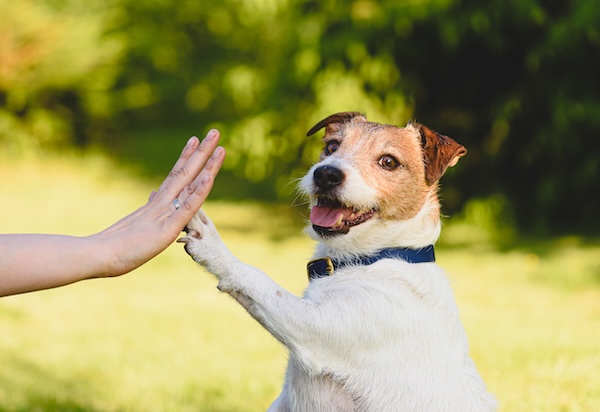
alexei_tm via iStock
Benefits of Teaching a High Five
Teaching your dog to high-five is a fun way to show off their smarts to your friends and family. But learning this skill can also benefit your pup in other ways, including:
- Helping them become more comfortable with having their paws handled (by you, their groomer, or vet)
- Building their confidence by learning something new
- Offering a polite way to greet guests (instead of jumping on them)
- Improving their balance and coordination
Training Tips for Success
When teaching a high five, keep your training sessions short and positive. Offer plenty of treats and praise in the process, and keep these additional tips in mind:
- Be clear and consistent with your hand position. This will prevent any confusion around what you’re asking for.
- Don’t raise your hand too high; make it as easy as possible for your pup to reach. “I like to start this trick with the dog on a raised platform and me on the floor or on a stool so I can hold my arm and hand comfortably but not too high at first and help my dog see my body language properly,” explains Nutkins.
- Don’t grab your dog’s paw and move it into position. Many dogs have sensitive paws, and grabbing them might actually make your dog afraid of the trick. Instead, allow them to figure things out and lift their paw on their own.
- Consider putting a non-slip mat or rug down during training. A little extra traction can add comfort and keep your dog from slipping.
Troubleshooting
While teaching a high five is a relatively easy trick, here are some common issues you may encounter, as well as ways to solve them:
- Your dog doesn’t lift their paw high enough. Is your hand too high for your dog to comfortably reach? Are you moving your hand away too quickly? Look at your own body language and adjust so it’s easier for your dog.
- Your dog drops their paw too soon. Build duration by gradually increasing the time your pup’s paw stays on your hand before you deliver a reward/treat.
- Your dog offers a nose touch instead of a paw. Make sure your hand placement for a high five is different than your hand placement for a touch. Typically, your hand will be vertical, palms up, for a high-five, and horizontal for a “touch.” Nutkins also advises ignoring a nose touch and moving your hand away. Reset, try again, and praise and reward as soon as you get a high five, she adds.
- Your dog confuses a high five with a shake. Again, your hand placement here is likely what’s causing confusion. “You can show a difference between asking for a shake and asking for a high five by reaching out to your dog with [your] hand facing upwards for a shake, and holding [your] hand upright, palm facing your dog for a high-five,” Nutkins explains.
Once you and your dog have mastered the art of giving a high-five, there are plenty of other tricks, behaviors, and skills to learn. For a comprehensive training plan tailored to your individual pup, learn how dog training works on Rover!