
Your first day with a new kitten is a rollercoaster—and among the many discoveries you’ve made, you’ve probably learned that your new friend needs a lot of supervision. But what about when bedtime rolls around? Where should your kitten sleep?
Your kitten should sleep somewhere in your home that’s quiet, safe, and warm. This could be in your bedroom or in a separate room, like a bathroom, laundry room, or spare room. Wherever you choose, you’ll want to make sure it’s fully kitten-proofed and has all the essentials.

Stephen Quandt, a certified feline training and behavior specialist and founder of Cat Behavior Help, offers reassurance: a kitten’s first night isn’t going to have a big impact on their lives and how well they settle. But having a good setup can offer peace of mind.
Here’s how to set a kitten up for their first night in their new home.
Where Should a Kitten Sleep on Their First Night?
Quandt says kittens are generally safest in a small, confined space where they can stay warm, usually around 70 degrees Fahrenheit. Good options are:
- On your bed, as long as your bedroom is kitten-proofed
- In your bedroom, in a crate or playpen
- In a separate room that’s kitten-proofed
Wherever you choose, you’ll want to make sure your kitten has access to a cozy bed and a litter box.
Can a Kitten Sleep Alone on the First Night?
A kitten can sleep alone on their first night for up to eight hours. Some kitties may be happy on their own, while others may need some extra love to help them adjust. It’s up to you to decide what works best for you and your new friend.
“You can let your kitten sleep on your bed if you want to, so long as they are able to safely jump on and off on their own and the room has been kitten-proofed,” says Zazie Todd, Ph.D., a psychologist specializing in pet behavior and author of “Purr: The Science of Making Your Cat Happy.”
You do, however, risk some high-spirited play in the night, like attacks on your toes, hair licking, or cuddles. If you’d like a more restful night but want your kitten nearby, Quandt recommends bringing a crate into your bedroom, complete with a cozy bed and a litter box.
Dr. Todd advises new cat parents to think about where you want your kitten to sleep in the long run. She adds that if you have two kittens, they can cuddle up with the other when they want to sleep.

iStock/Bogdan Kurylo
How To Prep a Kitten’s Bedroom for a Comfortable Night’s Sleep
When you first bring your kitten home, Dr. Todd says it’s best to confine them to one room to start. She adds that your kitten should be the only pet with access to this room. Once they’re settled, they can begin to explore the rest of the home.
The room should have all the kitten essentials, such as a litter box, kitten bed, soft blankets, and food and water bowls. (Be sure to place your kitten’s litter box on the opposite side of where their bed and food and water bowls are.)
Other items your kitten will appreciate include a scratching post, a variety of kitten toys, and maybe even a cardboard box!
Dr. Todd shares the following tips on how to kitten-proof your new feline friend’s room:
- Make sure there’s nothing dangerous in the room. This includes toxic houseplants, electric wires, cords or strings, tiny spaces, and household cleaners or substances.
- Put a latch or lock on any cupboards so your kitten can’t get in.
- Prevent injury by removing or securing anything that might fall or tip over if your kitten knocks it.
- Remove any personal belongings that you don’t want your kitty to possibly damage.
She adds that kittens are also good at climbing—so good that some may even climb up you! If there are shelves in your kitten’s room, Dr. Todd says to make sure they’re safe for your little climber. A kitten playpen may be helpful in keeping them safe overnight. If there’s nothing for them to climb, consider getting a cat tree to satisfy their innate behaviors.
Will a Kitten Sleep Through the Night?
It’s no secret: cats sleep a lot. And kittens can sleep up to 20 hours a day! “A kitten will likely go to sleep at night, but they are not necessarily going to sleep all night long,” Dr. Todd says. Cats are crepuscular (not nocturnal), meaning they’re the most active before sunrise and after sunset. Because they sleep in short bursts multiple times a day rather than all at once, they have what’s called a polyphasic sleep pattern.
Nevertheless, they experience REM sleep, dreams, and deep sleep just like us.
3 Ways To Match a Kitten’s Sleep Schedule to Your Own
With a new kitten in the house, everyone is going to need their sleep! One good way to promote rest for all is to try to sync your kitten’s sleep schedule with your own. Here are some tips to encourage your kitten to sleep at night.
1. Schedule your kitten’s last meal right before bedtime
Due to their tiny tummies, kittens need more small meals per day than adult cats—four per day at first, then three per day once they hit 12 weeks. According to Dr. Todd, making sure your kitten eats their last meal of the day right before bedtime can help them settle down to sleep when you do.
2. Play and exercise with them
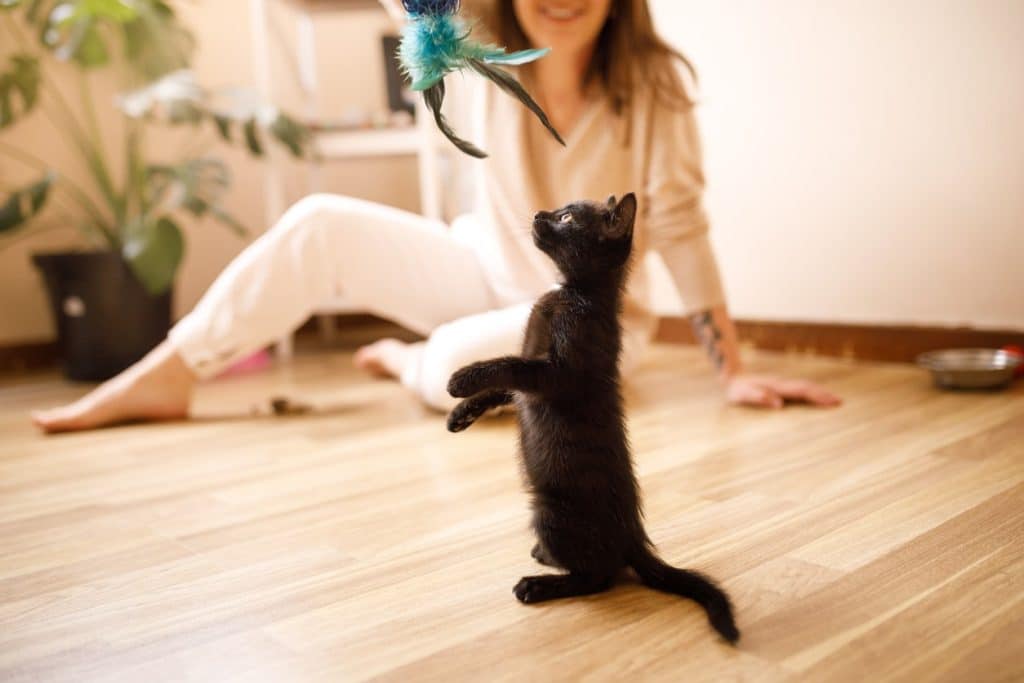
Playing with kittens before bed tires them out. A solid playtime session of about 10–15 minutes before it’s time to go to sleep will help them exert some energy and make them want to snooze.
“It’s very important to make time to play with your kitten, including with a wand toy (always put it away when not in use to keep your kitten safe),” Dr. Todd says. “You can also feed your kitten via food puzzle toys.”
Although kittens are highly enthusiastic, natural athletes, it’s possible to over-exercise them. Cease playtime if you notice your kitten is panting, exhausted, or showing signs of overstimulation.
iStock/Capuski
3. Help them feel safe with a familiar object
Cats have an excellent sense of smell that ultimately provides them a sense of comfort if they’ve marked an object, especially when it comes to adjusting to a new home.
“If bedding has their scent, that familiar scent helps them to feel safe,” Dr. Todd explains. “They transfer pheromones when they rub their head on things, and that helps them to feel safe, too.”
In addition to providing them with familiar objects like blankets, toys, and scratching posts, Todd says you can also use a pheromone diffuser to help make them feel safe.
Takeaway
While welcoming a kitten into your family is a joyful time, it can bring with it new challenges for new and even seasoned cat parents. With a little patience and a whole lot of love, navigating your kitten’s first night of sleep and taking care of them in the long run will be a breeze.