• Skip to primary navigation
  • Skip to main content
  • Skip to primary sidebar
Our website uses cookies. By continuing to use our site, you agree to our use of cookies. To see what cookies we serve and set your own preferences, please review our Cookie Policy. Learn More.

The Dog People by Rover.com

Powered By Rover.com

Tips, stories, and reviews for people who love dogs, powered by Rover.com, the world's largest network of 5-star pet sitters and dog walkers.

  • The Dog People by Rover.com
  • Dog Breeds
    • Beagle
    • Boxer
    • Chihuahua
    • Dachshund
    • German Shepherd
    • Golden Retriever
    • Labrador Retriever
    • Poodle
    • Shih Tzu
    • Yorkshire Terrier
  • Dog Love
    • Cute
    • Funny
    • Heartwarming
    • Quizzes
    • Trending
    • True Stories
  • Dog Names
    • Dog Name Generator
    • Top Dog Names of 2020
    • Top Male Dog Names
    • Top Female Dog Names
    • Cool Dog Names
    • Unique Dog Names
    • Cute Dog Names
    • Tough Dog Names
    • Food Dog Names
    • Romantic Dog Names
    • Literary Dog Names
    • Country Dog Names
  • Dog Videos
  • Life with Dogs
    • Dog Safety
    • Dog Behavior
    • Dog Psychology
    • Dog Nutrition
    • Dog Training
    • Health and Wellness
    • Recipes
  • PuppyHQ
    • Dog Adoption
    • Puppy Essentials
    • Puppy Names
    • Puppy Training
  • Shopping
    • Shop Rover Goods
    • All Dog Product Guides
    • Dog Gift Guides
    • Safety and Training
    • Toys and Chews
  • Cats!
    • Cat Breeds
    • Cat Names
    • Cat Psychology
  • Grooming
  • Get Rover
    • Dog Boarding
    • Pet Sitting
    • Dog Walking
    • Doggy Day Care
    • House Sitting
    • Search Pet Sitters & Dog Walkers
    • Shop Rover Goods
    • Sitter Resources
  • Languages
    • en-GB
    • en-CA
    • es-ES
    • sv-SE
    • de-DE
    • fr-FR
    • nl-NL
    • it-IT
    • nb-NO
    • fr-CA

Feeling Depressed? There’s a Dog for That

SharePin It

Feeling Depressed? There’s a Dog for That

Training Your Dog
By Jacqueline Bennett

ShareTweetPin It

Sometimes when you’re down, all it takes is a lick to the face or a furry cuddle to lift your spirits. If you can’t own a dog yourself, spending time with dogs via family, friends, or as a pet sitter can give you some much-needed dog love. But what if your stress runs deep, or you’re anxious and nervous to leave the house, or find yourself severely depressed—can a dog still help bring you back?

There are many stories about how dogs have helped individuals with depression; Julie Barton’s poignant memoir Dog Medicine is among the best-known. What’s exciting is that formal research also shows that service and companion animals are effective in treating depression and anxiety, as well as improving overall health.

Advertisement

It’s possible to train a dog for service certification without going through an organization, though it takes a lot of work. A well-reviewed guide like this one is a good starting place. Also, certain breeds are more commonly used for service work, but many different breeds can make wonderful therapy animals.

How Service Dogs Help Humans with Anxiety and Depression

The therapeutic power of pets is well documented and having an animal can help lift your anxiety or depression. Photo courtesy of The Elizabeth Hospice.

The therapeutic power of pets is well documented; having an animal can help treat anxiety or depression, or simply brighten your day. Photo courtesy of The Elizabeth Hospice.

Often times, those with depression or anxiety avoid contact with the outside world, either out of fear or stress of what might happen.

“Anxiety and depression involve emotional turmoil and negative internal ‘self-talk,'” Dr. Katie Kangas, co-founder of the Pet Wellness Academy, explains. “These thoughts typically spiral into unrealistic negativity and this continues in a vicious cycle.”

Dogs help break that cycle by providing comforting companionship and a sense of purpose for their owners.

Dr. Kangas and Certified Behaviorist Colleen Demling weigh in on some of the other ways dogs can help those suffering from depression:

  • Responsibility for their well-being. “A dog needs to be fed, needs to be walked, and needs to be pet, so on days when a person feels least motivated, a thump of a happy tail motivates a person to get back to living,” Demling says.
  • Unconditional love. “This 100% acceptance without judgment when a person is depressed, anxious, lonely, wearing the same clothes as yesterday and can’t get out of bed helps people feel like they have a true friend during their difficulties,” Demling says.
  • Recognize signs of a panic attack. “The mere presence or non-reaction to a stimulus of a trusted companion often calms an attack,” Demling explains. “Dogs can also be trained to use passive methods to block strangers from approaching their handler unexpectedly.”
  • Staying connected. “In today’s society, with the advance of internet and technological connection, we are losing real interpersonal connection, and that is contributing to more emotional problems and disorders,” Dr. Kangas explains. “Love and connection does exist in the world, and animals are a great resource to find this within one’s life.”

Service Dogs Helping People Cope with PTSD

There are a growing number of organizations dedicated to training service dogs to help those suffering from PTSD, particularly veterans. In fact, dogs have been proven so effective at helping combat anxiety, stress, and depression, the government provides funding to these groups.

canines-for-warriors

Matt and his dog Dozer from K9 For Warriors.

K9s For Warriors is a little different. The program was founded by Shari Duval, the mother of former K9 police officer and Iraqi combat veteran Brett Simon, who returned from two tours of duty with PTSD. They accept no government funding, relying instead on the generosity of donors, and there are no out-of-pocket costs for participants for the 21-day program or for their service animal. In their first year, they wanted to help a dozen service members a year—now with expanded facilities, they serve nearly 200.

Matt Masingill is the Lead Warrior Trainer for K9s For Warriors. He came to the group first as a participant, and with a bit of hesitation.

“I was skeptical, but my wife thought it was a good idea, so I came,” Masingill says.

“It is a life-altering experience. The dog is just there for you; there’s no judgment, no negative feedback.”

Before Warriors, Masingill says daily life was difficult.

“Like so many other vets, I went to the VA and they thought drugs were the option,” Masingill explains. “It wasn’t helping or mitigating my symptoms, it was just masking them. I didn’t leave my house—I just suffered from a lot of anger and paranoia.”

But all that changed less than a year after being paired with his service dog, Dozer.

“In the first 270 days, I had 248 violent nightmares,” Masingill recalls. “Dozer woke me from 228 of them, which allowed me to get out of the miserable sleep pattern I was in, and get off the sleep and depression medications.”

Now, he’s helping other warriors. The organization rescues dogs they think will be good service animals, most of them with no time left at the shelter, and trains the dogs to recognize the signs of a panic attack, helping calm their veteran and get them on the road to recovery.

“Rescue a dog to save a vet, that’s how I see it,” Masingill says.

For Masingill, the job has become another form of treatment.

“I still fight [the anger] everyday, but K9s is perpetual therapy,” he explains. “We just want to spread the word.”

K9s For Warriors also helps people with Traumatic Brain Injury (TBI). They do have a waiting list but encourage anyone who needs help to inquire and apply online.

Pet Therapy—Making Spirits Bright

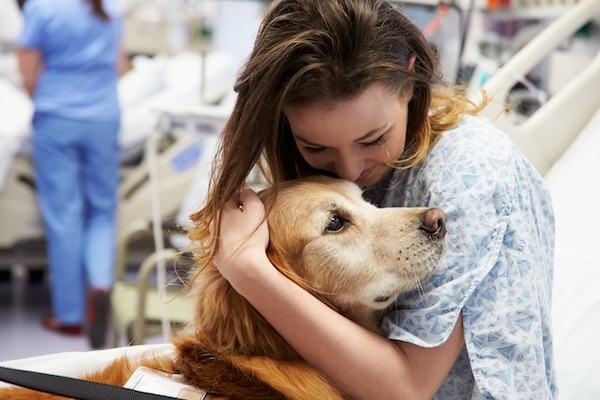
Dogs aren’t just used as service animals—they are also used as therapy animals, visiting the elderly or sick in their homes or hospice care.

Tali has been a therapy dog for six years, brightening the spirits of patients in hospice care or people in nursing homes. Photo courtesy of Lisa Marcolongo.

Tali has been a therapy dog for six years, brightening the spirits of patients in hospice care or people in nursing homes. Photo courtesy of Lisa Marcolongo.

Lisa Marcolongo has teamed up with her golden/Labrador retriever mix Tali to visit people over the past six years. Marcolongo also works part-time at The Elizabeth Hospice in San Diego, where residents love their four-legged visitors.

“They enjoy her presence and the warmth Tali brings,” Marcolongo says. “She puts her head in their lap so they can touch her head and she has been trained to gently get into bed and cuddle with them, so they feel that warmth. I think whenever people are not feeling well, touch and warmth are very important.”

Seeing dogs around also spark fond memories of life with dogs prior to the nursing home or hospice.

“There are some patients with dementia who may not remember what they had for breakfast that morning but a lot of times, they remember the animals they had growing up,” Marcolongo explains.

Here’s how it works: Pet therapy teams coordinate with social workers who offer a list of services to potential patients, dog therapy included. If the patient chooses pet therapy as part of their care, a team will be contacted and paired up with the patient.

There are also groups that visit nursing homes. Love on a Leash, a non-profit group in Southern California, will credential pet therapy teams and assign them to other agencies in need.

“It’s something the residents look forward to,” Marcolongo says. “It’s nice to see the response from the patients. It just brightens their day.”

Getting a Service or Therapy Dog

Colleen Demling partnered with the San Diego Armed Services YMCA to help develop and maintain their Therapy Dog Program and has consulted with numerous private clients on their Service and Emotional Support Dog training needs. She says people might be surprised to learn not all organizations that provide service dogs are created equal.

“There is really no clearinghouse to start your search for a service dog,” Demling explains. “There are a lot of organizations popping up, trying to take a bit of the government money available for programs geared towards wounded warriors or civilians who have PTSD.”

Two sites where people can get educated and start the search by comparing organizations:

  • Delta Society
  • Assistance Dogs International (ADI)

Two organizations Demling particularly recommends are Canine Companions for Independence and Guide Dogs of America.

“I recommend calling one of these organizations and asking for guidance,” Demling says. “They are well-respected organizations so they are probably going to know other well-respected organizations that are training dogs for PTSD and other disabilities.”

Demling says don’t be afraid to look into a service animal if you think you won’t qualify.

“The only requirement for a dog to become a service dog is for a person to have a disability as defined by the ADA and the dog has a skill that is taught that directly assists that disability,” Demling explains.

If you have a minor disability, you may be able to train the dog yourself but most people will seek the help of larger organizations, which makes it important to check first with the two groups mentioned above. Any organization you work with should provide extensive training of at least a week with the dog either at your home or the group’s site.

“It allows the organization to give you the skill set to work with the dog and to make sure there is a personality match,” Demling explains. “They should help you problem-solve any difficulties you might have as they transfer the dog to you—they are hands-on, eyes-on to fix it.”

The cost of being paired with a service dog should be nominal or nonexistent.

“The larger non-profit organizations are funded independently through grants and fundraisers,” Demling says. “With a for-profit group, they will give you a service dog but will charge you $6,000. There are organizations that are chasing the money first and trying to help the person second.”

The Bottom Line

When someone is suffering from anxiety or depression, it may seem like there is no hope, but the unconditional love of a furry friend can turn their life around.

“Dogs can provide a powerful grounding, connecting, and healing force in our lives,” Dr. Kangas says. “What a beautiful thing!”

_

Top image via Flickr/Ohio University Library


 Find dog boarding services near you:

Austin, TX New York, NY Seattle, WA
Chicago, IL Portland, OR Washington, D.C.
Denver, CO San Diego, CA Houston, TX
Los Angeles, CA San Francisco, CA Las Vegas, NV

Don’t see your city on the list, visit us here to find a sitter in your neighborhood!

ShareTweetPin It

sidebar

By Jacqueline Bennett

Share This Article

ShareTweetPin It

Tips & stories by dog people, for dog people

Powered by Rover.com

Popular Posts

  • Sit Back and Get Cozy With These Dog-Themed Reality Shows, Streaming on HBO Max
  • Dog Pee Smell on the Carpet: How to Get Rid of it for Good
  • The 17 Best Puzzle Toys That Actually Help Bored Dogs
  • Tricks and Toys to Keep Dogs Busy When They’re Alone
  • January Is Walk Your Dog Month: Here’s How to Do It Right

The Dog People Newsletter

Sign up and get $25 off pet sitting and dog walking!

Powered by Rover.com
More from The Dog People
A woman bends down, smiling, towards her large dog, training to not jump up.

The 6 Best Dog Training Clickers According to a Professional Dog Trainer

Learn More

  • About Rover.com
  • Download the App
  • Rover Store
  • Sitter Resources
  • In The Press
  • Terms of Service
  • Affiliate Disclosure
  • User Terms
  • Privacy Statement
  • Cookie Policy

Need Help?

  • Help Center
Advertisement
© 2021 Rover.com. All Rights Reserved.