- Not a substitute for professional veterinary help.
Flowers are often gifted or placed around the home without much thought. As long as they’re pretty, that’s all that matters, right? Not if there’s a cat in the house.
According to Karry Giunti, a florist and owner of Serenity Flower Co., many of her customers are surprised to learn that several popular flowers, such as daffodils, lilies, and amaryllis, are toxic to cats. And because cats are naturally curious, any new bouquet that appears in the home is likely to be investigated (read: nibbled or eaten).

Renee Schmid, DVM, DABT, DABVT, senior veterinary toxicologist and director of veterinary medicine at Pet Poison Helpline, says that while some flowers may only cause mild stomach upset if consumed, others can lead to severe organ damage, even in very small amounts. That’s why knowing which flowers are safe for cats is essential.
Read on to learn which cat-friendly flowers are commonly used in bouquets, so you can enjoy or gift fresh blooms that won’t put feline companions at risk.
A Factsheet of Safe vs. Toxic Flowers
The short table below highlights popular cat-friendly flowers alongside the most common toxic ones. We focused on flowers you’re most likely to encounter in florist shops and grocery stores.
Note: The chart below is not exhaustive. There are other flowers that may be safe or unsafe for cats, so always double-check before bringing flowers into your home or gifting them to someone with a cat.
| Popular Cat-Friendly Flowers | Common Toxic-to-Cat Flowers |
| Asters (Aster spp.) | Chrysanthemum (Chrysanthemum spp.) |
| Orchids (Cymbidium, Dendrobium, Oncidium, and Phalaenopsis spp.) | Hyacinths (Hyacinthus orientalis) |
| Roses (Rosa spp.) | Daffodils (Narcissus spp.) |
| Sunflowers (Helianthus spp.) | Lilies; many varieties (Hemerocallis spp.) |
| Gerbera Daisies (Gerbera jamesonii) | Rhododendron (Rhododendron spp.) |
| Zinnias (Zinnia elegans) | Oleander (Thevetia peruviana) |
| Pot Marigold (Calendula officinalis) | Tulips (Tulipa spp.) |
| Limonium (Limonium spp.) | Azaleas (Rhododendron spp.) |
| Snapdragons (Antirrhinum majus) | Autumn Crocus (Colchicum autumnale) |
| Echinacea (Echinacea purpurea) | Cyclamen (Cyclamen spp.) |
| Statice (Limonium leptostachyum) | Kalanchoe (Kalanchoe tubiflora) |
| Waxflower (Etlingera cevuga) | Amaryllis (Amaryllis spp.) |
| Lisianthus (Eustoma grandiflora) | Begonias; over 1,000 species and 10,000 hybrids (Begonia spp.) |
| Stock Flowers (Matthiola incana) | Gardenia (Gardenia jasminoides) |
| Camellia (Camellia spp.) | Carnations (Dianthus caryophyllus) |
| Cosmos (Cosmos spp.) | Dahlia; many varieties (Dahlia spp.) |
| Pansies (Viola × wittrockiana) | Irises (Iris spp.) |
| African Violets (Saintpaulia spp.) | Hydrangeas (Hydrangea arborescens) |
| Goldenrod (Solidago spp.) | Holly (Ilex opaca) |
Popular Cat-Safe Bouquet Combinations
If you’re shopping for flowers, choosing individual cat-safe blooms is a great start, but it’s also helpful to know which flowers actually work well together in a bouquet. Based on commonly available florist staples, the following combinations are both visually balanced and cat-friendly:
- Roses, asters, and waxflower
- Sunflowers, gerbera daisies, statice
- Gerbera daisies, lisianthus, and snapdragons
- Zinnias, cosmos, and asters
- Sunflowers, goldenrod, and limonium
- Pot marigold, pansies, and violas
- Echinacea, sunflowers, and statice
- Lisianthus, roses, and waxflower
- Camellias, roses, and waxflower
Bouquet add-ons to watch out for
Even when the flowers themselves are cat-safe, bouquets often include greenery or decorative add-ons that can be harmful to cats. While not a complete list, common bouquet add-ons that are considered toxic or harmful to cats include:
- Eucalyptus
- Bulbs (even if the flowers themselves are removed)
- Dusty miller
- Ruscus
- English ivy
- Decorative berries
- Decorative seed pods
- Pine greenery
- Feverfew
- Baby’s breath (non-toxic but may cause GI upset)
- Leatherleaf fern (non-toxic but may cause GI upset)
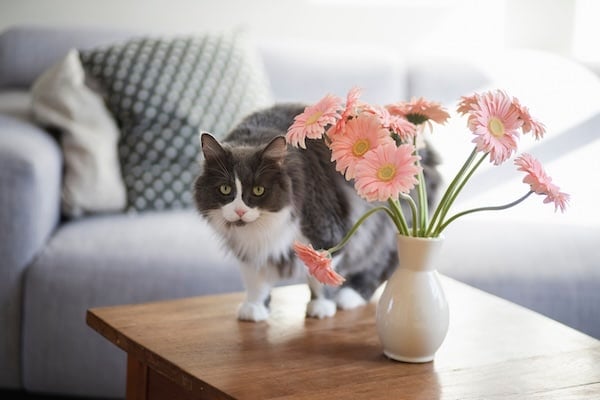
Linda Raymond via iStock
Flower Safety FAQs for Cats
What precautions should you take around cats and flowers?
First and foremost, always check the safety of flowers before bringing them into your home or garden, or gifting them to someone with a cat. But even when you’re choosing cat-safe flowers, it’s still best to keep bouquets out of reach, as eating too much of any flower or plant can lead to an upset stomach.
How can you cat-proof flowers in your home?
“A vase of flowers on the kitchen counter can quickly turn into a tipped-over mess with a pool of water all over the floor,” says Chad Kremp, vice president of sales and co-owner at Kremp Florist. “Cats also love to nibble and chew on leaves, petals, and stems,” he adds.
That’s why some simple cat-proofing can go a long way toward reducing the risk of your cat knocking over a vase or munching on a bouquet:
- Use heavy, tip-resistant vases to help prevent spills
- Place flowers on high shelves or behind closed doors
- Avoid floor-level displays or coffee tables
- Keep cats away from vase water, which may contain plant toxins or preservatives
- Clean up fallen petals or leaves
If your cat is especially curious and determined, skipping cut bouquets altogether and opting for cat-safe potted plants may be safer.
What signs or symptoms should you watch out for?
If a cat has chewed on flowers or foliage, Dr. Schmid says signs to watch for include:
- Vomiting
- Diarrhea
- Lethargy
- Decreased appetite
- Increase in drinking and urination
These symptoms may suggest gastrointestinal irritation or a more serious toxic exposure. If your cat shows any of these signs, or if you suspect they’ve ingested a toxic plant, contact your veterinarian or Pet Poison Helpline at 855-764-7661 right away for guidance.
Can non-toxic flowers still cause problems if eaten?
Yes, Dr. Schmid says even non-toxic flowers can cause mild gastrointestinal upset if a cat eats a large amount. This may include vomiting, diarrhea, or decreased appetite. If symptoms are mild and short-lived, home monitoring may be sufficient. However, if symptoms persist, secondary issues like dehydration can develop and should be evaluated by a veterinarian.
What flowers or plants are safe for cats to eat?
Most flowers, even non-toxic ones, aren’t meant for cats to eat regularly. If your cat enjoys chewing on plants, safer options include catnip or cat grass.
How do I know if a flower is cat-friendly?
If a flower isn’t listed in this guide:
- Ask the florist or shop for the exact plant name
- Look up both the common and scientific name
- Check Rover’s plant safety database to look up specific plants and confirm whether they’re safe for cats