
Hey, I’m JP, an engineer on the Acceleration Team at Rover. Our team focuses on building a Growth Engine that generates sustainable customer growth through product usage.
I’ve been at Rover for four and a half years now, and this April I had the opportunity to attend the 2026 edition of DjangoCon in Athens, Greece.
This was only the second conference I’ve attended since joining Rover in 2021, and I have to say, I really enjoy these experiences. They’re a great way to learn from others, exchange ideas, and step outside of our day-to-day work for a moment.
Athens, Greece

This year’s conference took place in Athens, Greece, about 1,900 km away from my home in Barcelona, yet still very much within the Mediterranean Basin.
Athens felt familiar in many ways, but also distinctly different. The people, the pace, the food, the colours, the atmosphere, the city has a rhythm entirely its own.
I’ve also been trying to get back into photography recently, and Athens turned out to be an incredible place to walk around with a camera. I’ll share some of my favourite snaps throughout the post.
Athens Conservatoire
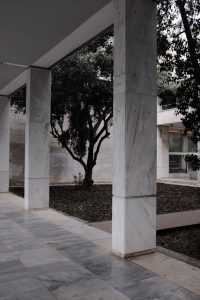
The conference was held at the Athens Conservatoire, an architecturally striking building.
Bauhaus-inspired, modernist in design, marble-clad, and seemingly unfinished, the Conservatoire immediately stood out to me. Naturally, it also made for a great photography subject.
While exploring beyond the conference areas, it quickly became apparent that the building is used for far more than music and performance. Parts of it felt repurposed and adapted over time, including spaces used as a kindergarten and school.
It gave the impression of a building continuously evolving based on what is needed, rather than rigidly remaining what it was originally designed to be.
Three Days of Talks
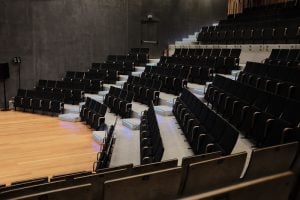
The conference ran over three days, with one keynote each day followed by talks from different speakers.
The format actually reminded me a lot of our internal Tech and Treats sessions at Rover; engineer-led presentations where people share what they’ve implemented, how they approached it, and what they learned along the way.
The topics covered a wide range of subjects, from updates to the Django library and efforts to refactor the Django Admin, to state management using signals and even using Django to help process data for the world’s largest X-ray observatory.
Day One: Carlton Gibson
The first keynote was presented by Carlton Gibson, who brought a huge amount of energy to the stage.
His talk focused primarily on using types in Django, but what really stuck with me was a tangent into DRY and separation of concerns.
I always enjoy moments like that during talks, when someone drifts into a completely different topic because that’s where their thinking naturally leads them.
One quote in particular stayed with me:
“Don’t repeat yourself unless you need to. If you keep everything DRY, you might be coupling code that should not be, making it harder to decouple later. If concerns are separate, then you should NOT keep the code DRY, you should, in fact, repeat yourself.”
Security, AI, and Signal vs Noise
Another talk that really stood out was led by Markus Holtermann from Django’s Security and Ops teams.
He spoke about the surge of security issue reports they’ve been receiving since November, but also about the noticeable dip in the quality of those reports.
The team has had to become increasingly assertive about triaging submissions: requiring proper reproduction steps, clear definitions, and discarding low-quality reports in order to keep up with the volume.
It was a really interesting example of the broader impact AI is having right now. We’re seeing an explosion in content generation and productivity, but also an increased need to evaluate quality, filter noise, and review outputs critically.
Exploring Athens
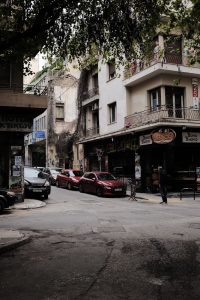
Outside of the conference itself, I spent a lot of time exploring the city.
One neighbourhood I particularly enjoyed was Exarcheia, full of cafés, street art, bookstores, and a strong alternative character. Walking around Athens with a camera became one of my favourite parts of the trip.
The city feels layered in a very interesting way: ancient history, modernism, unfinished infrastructure, philosophy, nightlife, and daily life all existing on top of one another.
Marlene Mhangami: Agentic AI
The second keynote, led by Marlene Mhangami, focused on practical ways of working with agentic AI.
One idea that really resonated with me was that, right now, we are all beginners and experts at the same time. The space is evolving so quickly that everyone is constantly learning new workflows and approaches.
The talk focused heavily on practical AI usage:
- breaking work into smaller tasks
- planning with AI in mind
- providing clear guardrails
- using existing patterns and examples
- avoiding “one-shot” solutions
That point in particular came up repeatedly throughout the conference: AI works best when the problem is properly scoped and structured.
Real-World AI Usage
One of the most interesting practical examples came from a talk led by Andrew Northall.
The project focused on work done with the National Speleological Society, which has accumulated decades of reports and documentation dating back to the 1950s.
Using AI, they were able to digitise, summarise, structure, and analyse this information in ways that would have been incredibly difficult manually.
It was a great example of AI being used as a genuinely useful tool — helping people navigate and make sense of large amounts of information rather than simply generating content for the sake of it.
Athens Through a Lens

Athens turned out to be an incredibly photogenic city.
Between the marble buildings, the warm evening light, the contrast between ancient ruins and modern apartment blocks, and the constant movement of people through the streets, there was always something interesting to frame.
The Athens Conservatoire especially stayed with me. The building felt unfinished, adaptive, constantly negotiating what it could contain and what it needed to become.
Daniele Procida: “Body of Knowledge”
My favourite keynote of the conference was presented by Daniele Procida.
Rather than feeling like a traditional conference talk, it felt more like a university lecture grounded in philosophy and critical theory.
Although the talk focused on Django documentation, how knowledge should be structured to remain digestible, accessible, and usable, I couldn’t help but apply many of the ideas to AI as well.
One sentence in particular stayed with me: “Knowledge must fit the body.”
AI and Human Limits
That idea kept echoing in my head throughout the rest of the conference.
We live in a time of rapid technological transition, and I think we’re still learning how to use these new tools properly.
We hear a lot about:
- hallucinations
- low-quality outputs
- “AI brain fog”
- burnout caused by constant context switching
But often, these are symptoms of poor AI usage patterns.
We can’t simply “one-shot” large projects and expect great results. Instead, we need to learn how to scope, plan, break down, review, and structure our work in ways that fit us as humans.
Because ultimately, we are finite.
Spawning multiple agents working on multiple unrelated tasks also means that we, as humans, need to carry all those contexts simultaneously. And that has a cognitive cost.
AI can extend our capabilities, but it still needs to fit within human limitations.
Rocket Science with Django
The final talk that really stayed with me was presented by Loes Crama.
The project focused on an X-ray observatory planned for launch in 2037, and how Django is being used to process the data collected by the satellite.
At one point, the presentation mentioned a structure involving 2,400 mirrors made from over 100,000 individual plates.
It genuinely felt like rocket science.
And yet, it was incredible to see how the exact same framework many of us use for day-to-day web development can also help power scientific projects at that scale.
That’s one of the things I love most about conferences like DjangoCon: seeing the completely different ways people use the same tools.
Final Thoughts

One thing Athens, the conference, and the Conservatoire all made me think about is adaptation.
The Conservatoire was originally designed for one purpose, but over time it evolved into something broader, a building shaped not only by intention, but also by practical reality.
In many ways, AI feels similar.
The challenge is not to use AI everywhere simply because we can, but to use it intentionally, in ways that genuinely support how we think, work, and collaborate.
No workflow is universal.
We need to learn how to use AI in ways that fit us.