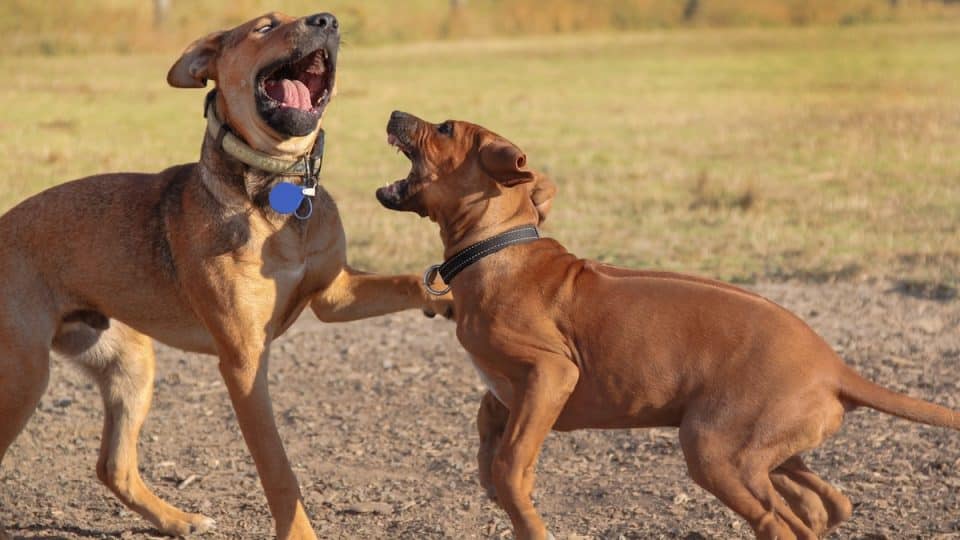
Bringing your dog to a play session is all fun and games—until they get into a scuffle! But knowing how to tell if your dogs are playing or fighting can actually be quite tricky. Many dogs enjoy wrestling and playfully roughhousing, which can look like growling, tackling, and neck biting each other. Knowing what qualifies as play fighting versus the real deal, however, is crucial to keeping everyone safe. So how do you know the difference?
Context and body language are the keys, according to Brian Zeman, assistant director and certified dog trainer (CPDT-KA) with PAWS Chicago, and Harleigh Poulson, a certified dog trainer (CPDT-KA) at VCA Willow Creek Pet Center.

With their help, we cover what to watch for to tell the difference, plus how to monitor play and when to seek professional assistance if your dog continues to display unwanted behaviour with other pups.
Playing vs. Fighting Cheat Sheet
| Physical Characteristic | Play Fight | Real Fight |
| Growling | X | X |
| Raised Hackles | X | X |
| Falling/Rolling Over | X | |
| Trying to Escape | X | |
| Nipping/Neck Biting | X | X |
| Stiff Body | X | |
| Pinned Ears | X | |
| Tucked Tail | X | |
| Bowing | X | X |
Signs of a Play Fight
Watching your dog’s body language and behaviour is key to determining whether an interaction with another dog is healthy. “Guardians should watch for changes in the rhythm of play, making sure there’s a healthy back-and-forth and that no dog is consistently pushing boundaries,” says Poulson. The following signs separate playful banter from a real fight.
Loose, bouncy body language
“In general, playful dogs have loose, wiggly movements and relaxed body language that shows they are engaged and having fun,” says Zeman. They’re not feeling stressed or threatened when inviting another dog to play, so their bouncy movements are simply a way to show they’re energised and excited.
Play bowing
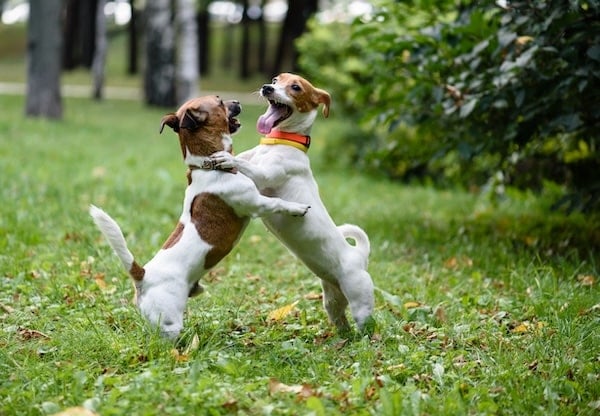
“A play bow is when a dog stretches their front legs forward and dips their chest to the ground,” says Zeman. “This is one of the clearest invitations to play. Most often, it’s used to say, ‘I’m friendly, let’s have fun!’ Between dogs that know each other well, a play bow may be more exaggerated and bouncy, signalling excitement and playfulness.”
Zeman adds that among newly introduced dogs, the bow can serve as a gesture of peace. “Play bows can even help de-escalate situations if they get too rough.”
Exaggerated growling and sneezing
Vocalisations can also help you understand your pup’s moods. You might be alarmed to hear your dog growling when engaging in rough and tumble, but these grumbles can be a sign of play. Harmless growls are usually high-pitched and accompanied by tail wagging, play bowing, and relaxed movements.
Sneezing is also a common way dogs communicate when they’re feeling playful, excited, or want attention. Playful sneezes are usually quick and shallow and accompanied by a wagging tail or other friendly behaviours. However, if your dog starts to sneeze while turning their head or backing away from another dog, it can be a sign that they need a break from the interaction.
Falling down
Rolling over is one of the most significant signs that a dog is just there for a good time. This action invites another dog to play and is a sign of vulnerability and trust. You might also notice both dogs taking turns falling or rolling over, which means they want the fun to continue.
“Dogs engaged in healthy play will also take turns: one chases, then the other chases,” says Poulson. “If one dog is larger or stronger, you’ll often see ‘self handicapping,’ such as a big dog lying down to play with a smaller one, or a fast dog slowing down so the slower one can catch up.”
alexei_tm via iStock
Signs of a Real Fight
“A fight can break out even if one dog thinks they are playing,” says Poulson. “If the other dog feels scared, overwhelmed, or trapped, the interaction is no longer appropriate.”
Even a well-mannered canine might find themselves in a quarrel if they feel cornered, so it’s important to safely remove your pup from a situation when they feel uncomfortable. The signs below warn that a real conflict is brewing.
Stiff body with efficient movements
Unlike the relaxed, loose body language in playful encounters, fights are tense and stiff. “Warning signs include rigid or frozen bodies, standing over another dog without moving, or both dogs rearing up on their hind legs,” notes Poulson. If you notice that your dog is suddenly going rigid, it’s time to move away.
Raised hackles
Dogs often raise their hackles when they perceive a threat, but they can also do it when they’re aroused during play. If you’re unsure if your pup is raising their hackles as a defensive strategy, look for additional warning signs, such as lip-licking, excessive panting, and barking.
Closed mouth and curled lip
A dog with a happy, open mouth may suddenly close it when going on high alert. This action, combined with snarling and baring teeth, is an indication that the interaction is not a friendly one. Observing changes in your dog’s body language can help you understand when your pet is on edge.
Pinned ears and tucked tails
A wagging tail doesn’t always mean a dog is happy. Some pups will quickly wag their tail as a warning sign for other dogs to back off. However, the most telling sign that a dog is uncomfortable is if they tuck their tail between their legs. A tucked tail usually means they’re scared or stressed, especially when combined with flattening their ears against their head.
Looking to escape
During a tense interaction, the dog who didn’t instigate the conflict may want to get out of there. When a dog tries to escape a situation by hiding behind their human, backing away, or avoiding eye contact, they’re giving an S.O.S signal.
Unlike the playful chases and tussles that occur when two dogs take turns and have fun, Poulson says that one dog may be trying to escape while the other relentlessly pursues. This imbalance can create tension, making the dog who is trying to get away feel like they have to defend themself if they can’t find a way out of the situation.
Monitoring Dog Play
Even well-socialised pups who have spent time around other dogs from an early age can get into scuffles. And just because two dogs are having a fun pretend scrap doesn’t necessarily mean it’s safe. Things can switch in an instant, and play can sometimes turn into fights.
Play can turn serious, for example, if one dog ignores the other’s cues for space. Alternatively, there may be a size difference that’s causing the smaller dog to feel threatened, or one dog may be in pain and get bumped in the spot that hurts.
With so many variables at play, it’s essential to keep an eye on your dogs and watch for the following:
- Breed-specific features that might make it hard for the other dog to read their body language. For example, a dog with a wrinkly face or no tail may not display physical signs as easily as other breeds.
- Group dynamics. When more than two dogs are playing, it’s crucial to prevent one dog from being ganged up on. Even if it’s playful, this can be a scary experience that evokes fear down the line.
- Avoid adding food, toys, and chews to the mix. While it may seem fun to toss a toy or treat to a pair of playful pups, these high-value items could lead to resource guarding or possessive tendencies.
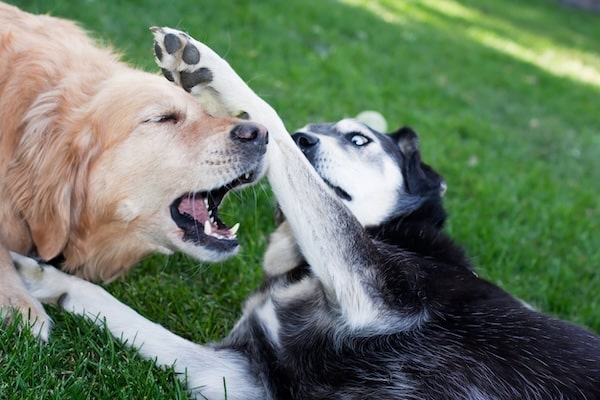
“A helpful strategy is to practice check-ins during play,” says Poulson. “For example, call your dog out of play for a quick break and then use the chance to go back into play as a high-value reward. This reinforces breaks, keeps dogs tuned in to their humans, and lets you assess whether both dogs are still enjoying the interaction. If one doesn’t want to return to play, that’s a clear sign it’s time to stop.”
EmilySkeels via iStock
How to break up a dog fight safely
“Dogs often signal discomfort well before things escalate,” says Zeman. “Look for subtle cues such as lip licking, giving side-eye, freezing, or trying to walk away. If you notice these signs, calmly separate the dogs before play turns to conflict. Dogs are excellent communicators, and it’s up to us to recognise and respect their signals.”
If a fight breaks out, your first instinct may be to pull your dog to safety, but physical intervention can put you at risk of a dog bite. Before intervening, try distracting the dogs by clapping your hands or making a noise. You can also use an object to create a barrier, such as a piece of cardboard or anything large that keeps your hands away from snarling mouths.
If these options aren’t successful, a last resort option is holding your dog’s thighs to lift them into a wheelbarrow position and pull them backwards. Avoid reaching for their collar, since you may end up getting bitten.
The Importance of Socialisation
According to Zeman and Poulson, early socialisation can prepare your dog for healthy canine interactions and reduce the risk of fights.
“Early interactions leave lasting impressions, so it’s important to go slowly, match dogs with compatible play styles, and ensure each experience ends on a positive note,” Zeman explains. “By reinforcing calm, friendly encounters, you help your dog build healthy associations that will benefit them for life.”
Poulson agrees that it’s crucial to start socialisation early and thoughtfully. Avoid uncontrolled areas like dog parks and focus instead on supervised playdates. “Your goal is to help your puppy learn how to play appropriately and read other dogs’ signals while ensuring no one gets overwhelmed.”
“Puppy classes are a great resource for new pet parents,” adds Poulson, noting that these group training sessions expose young pups to a variety of breeds and play styles.
When To See a Professional
Understanding your dog’s body language isn’t always easy. Like humans, dogs have shifting moods and boundaries. On top of that, certain breeds, such as Boxers, Huskies, and German Shepherds, have play styles or postures that are especially hard to read, and early signs of discomfort can be subtle.
Many pet parents find initial advice helpful by uploading their videos to Reddit. Asking a professional trainer to take a look, either at a video or in person, is an even better step. These experts can provide insight into your dog’s specific personality and needs, and they can help you create a behaviour plan to keep dog-to-dog play safe.
Most importantly, a professional trainer can teach you how to read your dog’s specific signals and advocate for your pup. As Poulson notes, it’s important for dogs to learn that their body language will be respected and that their humans will stand up for them if they need help. The better you get at it, the stronger the bond and trust with your dog becomes.