
We all love our pets—but what kinds of relationships we build are increasingly defined by the generation we belong to.
A 2026 Rover survey* found significant differences in how pet parents from four generations** approach pet parenthood, spanning everything from how much it’s reasonable to spend each month to where you bring your furry friend.
Yet while lifestyles and attitudes clash, pets are the undeniable winner, benefiting from a rising standard of care that cuts across generational differences.
Here’s a look at the findings that separate—and unite—the generations.
Best Friend or Child? Generations Disagree
There’s no question that pets bring meaning to our lives. A full 89% of pet parents say having a pet is essential for their personal fulfillment and agree that their dog is part of the family.
Younger Canadians are more likely to see their pet as a child (58% of Gen Z compared to 52% of boomers), while more boomers favor the designation “best friend” (60%).
Could this divide grow over the years? Our survey data suggests yes, as younger generations are more likely to see pets as kid-like in several ways:
- 44% of Gen Z and 36% of millennials agree that having a pet can be a good trial before having a human child—compared to just 24% of boomers.
- Younger pet parents are also more likely to prioritize the same requirements for adopting pets as for having children—especially when it comes to financial security.
- Boomers, on the other hand, tend to value emotional readiness before financial stability for pets—but finances come first for kids.
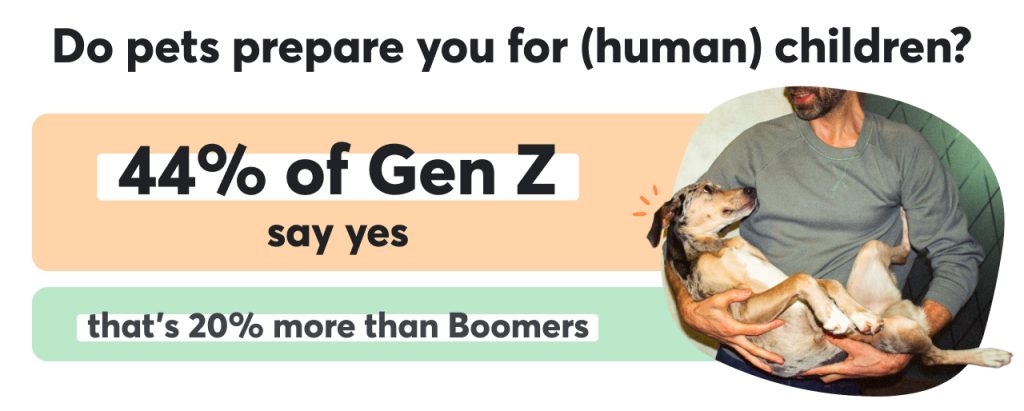
There’s been a lot of media buzz about young people going childless in preference for pets—and there may be some truth to it. Millennials are almost twice as likely as any other generation to report delaying (5%) or not having (11%) children and having a pet instead.
So what explains the generational shift?
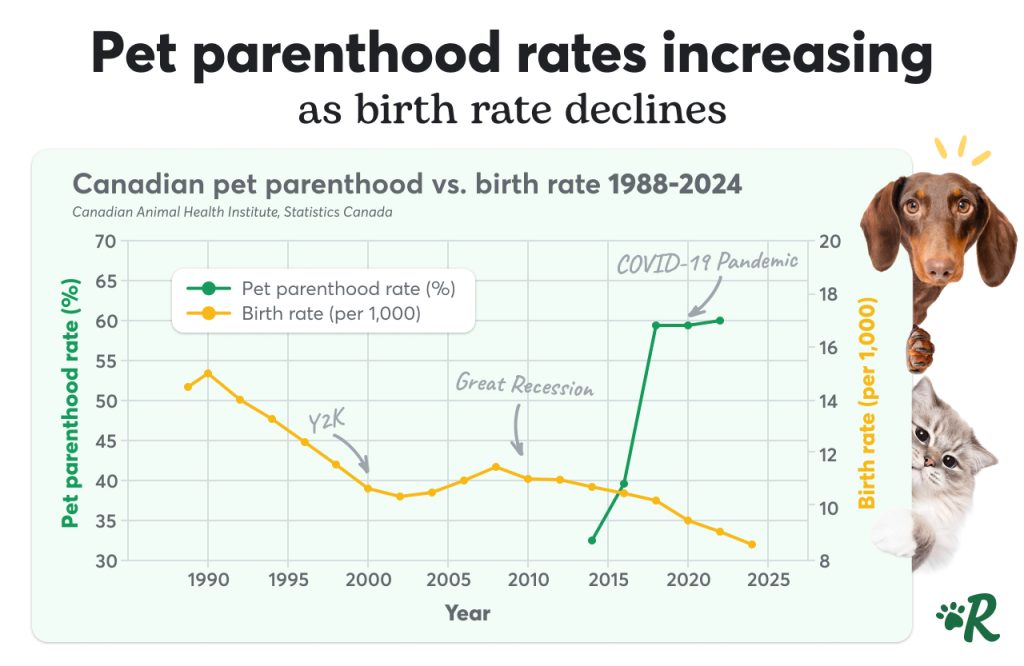
One factor behind the cultural shift from “best friends” to “children” may be increasing economic pressure.
While pets can be expensive, they still aren’t anywhere near as costly as kids.
In 2025, Rover estimated the average lifetime care cost was $35,639 for dogs and $43,340 for cats. By contrast, Statistics Canada estimated the average cost of raising a child from birth to age 17 in 2017 was $293,000. Adjusted for inflation, that’s $375,000 today.
In annual terms, that’s about $2,700 for a dog and $22,000 for a child.
Gen Z and younger millennials currently have the lowest median earnings of any generation. And 51% of Canadians between the ages of 18 and 34 report that money is their greatest source of stress, compared to less than half of older Canadians.
While young people build the capital necessary to start a family, some say pets offer a more affordable opportunity for love and caretaking—one akin to the role a child might play.
The Benefits Are Universal, But Which Ones Matter Depends on Your Age
Though generations might build different relationships with their pets, there’s one point that unites almost all pet-lovers: the value of a pet to our wellbeing.
Rover’s survey found near universal agreement (97%) that pets meaningfully impact a person’s wellbeing, with 82% highlighting emotional wellbeing and 53% highlighting physical wellbeing.
Most (85%) agree that their dog’s love is one of the most important contributors to their overall happiness. And 7 in 10 pet parents say having a pet makes it easier to develop friendships and relationships.
But exactly which benefits do you think are most meaningful?
Boomers were slightly more likely to point to the physical benefits of pet parenthood.
Gen Z, Y, and X were more likely to agree that pets improve their emotional and mental health, with a gap of 13 percentage points between Gen Z (88%) and Boomers (75%).
Younger people were also significantly more likely to see their pet as having social or community value beyond the home. In fact, 31% of Gen Z believe their pet plays an important role in the mental and emotional health of their community, compared to just 19% of boomers.
Generations Disagree on Bringing Pets Along
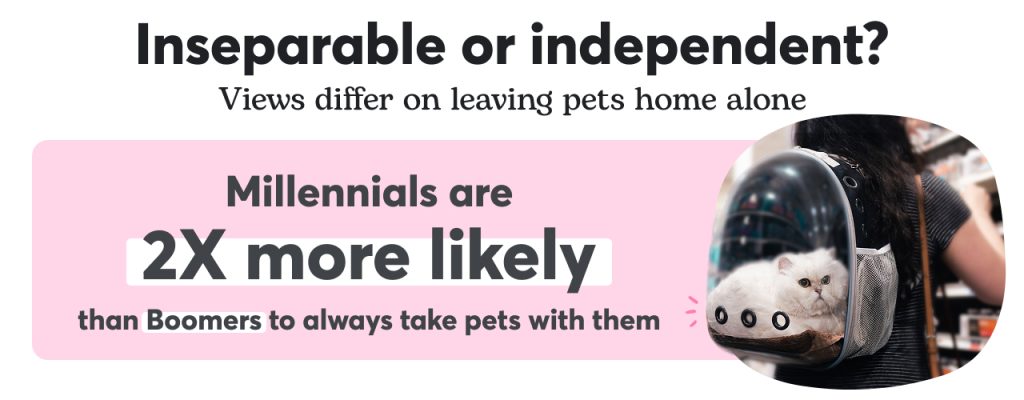
Younger generations broadly report the most integrated pet lifestyles, but millennials take the cake. More than half (58%) of millennials often or always take their pet with them when they leave home, and they’re twice as likely as boomers to report bringing their pet with them “all the time”—the most of any generation.
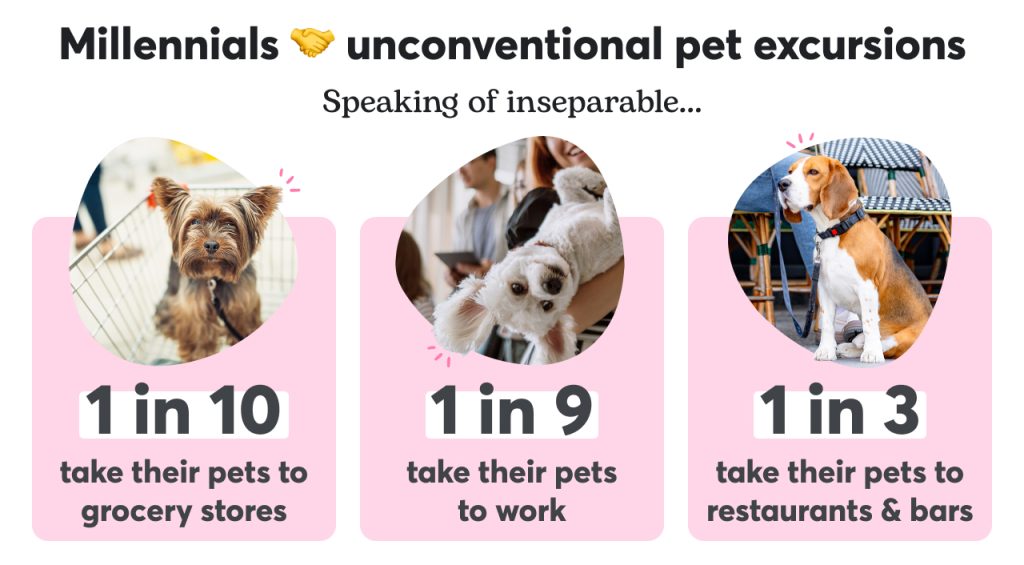
Millennials are the most likely to bring their pet on errands (42%), to the dog park (45%), and to work (11%). They’re two times as likely as boomers to bring a pet to a pet-friendly restaurant or bar (30%), and almost twice as likely as every other generation to show up at the grocery store with a furry friend in tow (10%).
Millennials and Gen Z are also more likely than any other age group to bring their pets on vacation, with 63% saying they bring pets some or most of the time.
Boomers and Gen X trail behind, being the generations most likely to “never” bring their pet with them when they leave home. Nearly half (46%) “never” bring their pet on vacation, compared to 35% of Gen Z and 38% of millennials.
But for the generations who don’t often bring a pet along, it doesn’t mean the love isn’t there—89% of pet parents of all ages report thinking about their pet often (a few times per day) or constantly (once an hour or more) when not with them.
People were also in agreement that pets come first in the big lifestyle decisions, like dating. Nearly two-thirds of pet parents reported they were unlikely to date a person who didn’t want pets, and 1 in 5 say it’s a non-starter. Boomers were the most likely to rule out romantic partners who didn’t want pets.
Phil Tedeschi, professor and researcher on the human-animal bond, isn’t surprised. He’s seen the same thing, saying, “Younger generations, in particular, are integrating pets more deeply into their daily lives and decision-making, while all generations continue to prioritize companionship and wellbeing.”
Generations Agree: The Standard of Pet Care Is Rising
Most (85%) pet parents agree that what “quality” pet care means has changed throughout their life, and 84% believe pets are better cared for today than in past generations. But what “quality” means varies by generation—whether it’s type of service or amount of spend.
Younger generations are expanding their definition of pet care, being consistently more likely to consider alternative therapies (think Reiki or hydrotherapy), dog sports, hosting parties for their pets, joining a dog gym, or even consulting a pet psychic.
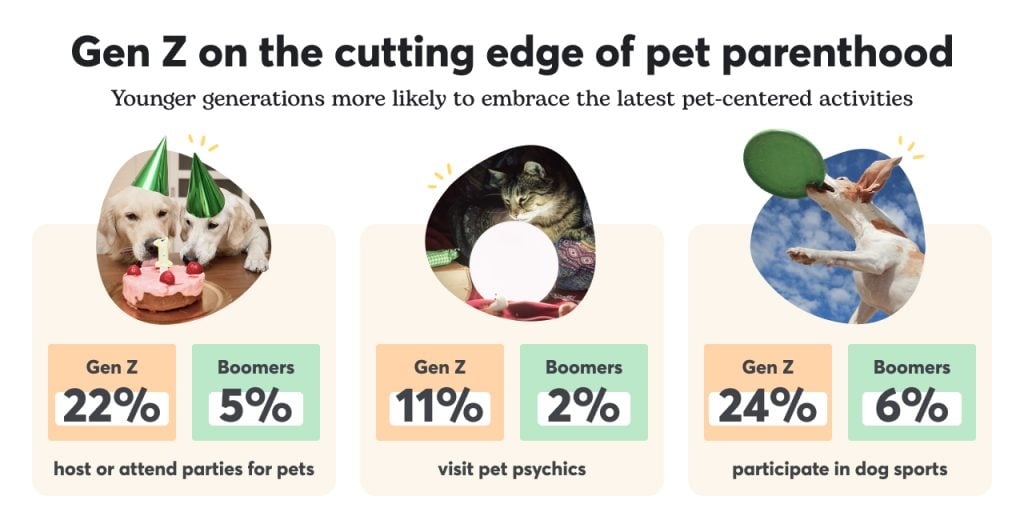
They also tend to take a more proactive approach to standard forms of care, illustrated by how often they visit the vet. Two thirds of Gen Z (73%) and Gen Y (65%) visit the vet “a few times a year” or “anytime something seems off,” compared to 45% of boomers and 48% of Gen X.
Gen Z is also the generation that’s least comfortable leaving their pet alone for more than eight hours, followed by millennials.
All of this—extra vet visits, new therapies, less alone time—comes with a financial cost.
When asked what they think is reasonable to spend on their pets each month, the majority (72%) of boomers say $100 or less, while 71% of millennials say $100 or $200. Gen Z is the most likely of any generation to consider spending $300 per month.
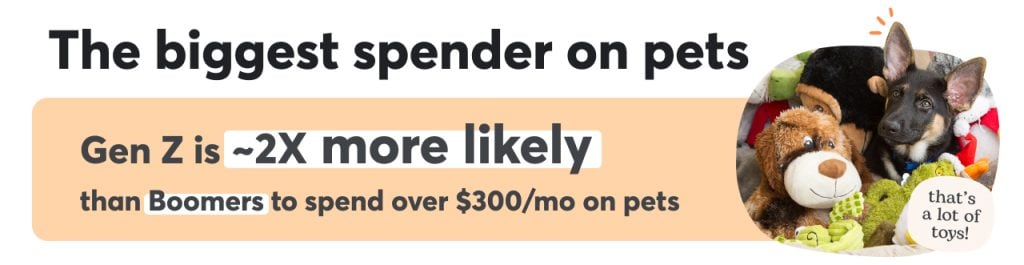
Given the impact on their wallets, perhaps it’s not surprising that Gen Z (88%) and millennials (84%) are more likely to say their definition of quality pet care has changed in their lifetime, compared to 74% of boomers.
Nor is it surprising that millennials and Gen Z tend to rate “financial stability” higher than older generations as a prerequisite for adopting a pet.
Where’s Your Village?
You support your pet—but who supports you? The answer might depend on your generation.
Vets are still number one: 81% of pet parents say the vet is an essential part of their pet’s care team. And they’re every generation’s first choice for advice when they feel “frustrated or uncertain” about a pet’s behavior.
But vets aren’t the only choice, especially for younger generations, who are increasingly building larger, more professionalized care teams around their pets’ specific needs.
Nearly one in five (18%) Gen Z pet parents agree that trainers are an essential part of their pet’s care team—compared to just 6% of boomers. They’re twice as likely to consult trainers for advice when frustrated or uncertain about their pet’s behavior.
Among Gen Z, 37% report that a groomer is essential to their pet’s care, compared to 27% of boomers.
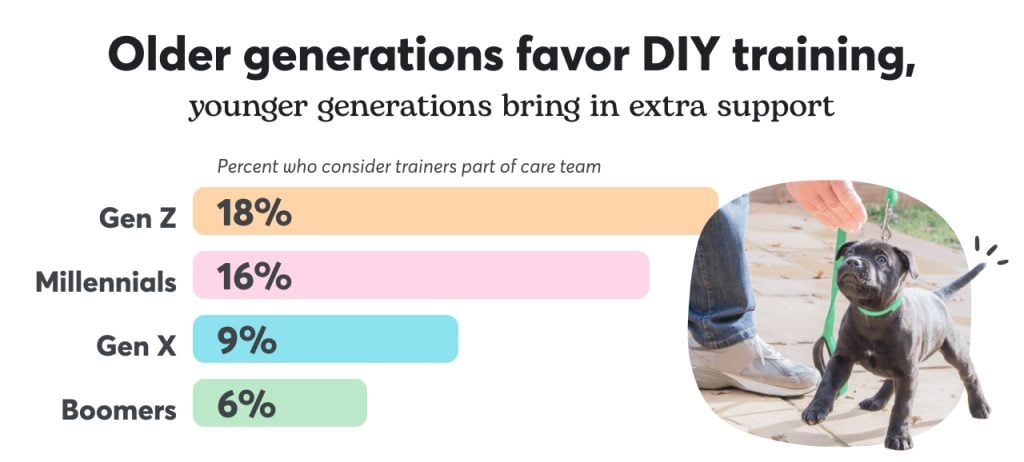
It’s not that older generations don’t think support matters—but Rover’s survey shows they rely more on smaller personal networks versus professional teams for their pet’s care.
Older generations are also more likely to turn to traditional sources for help and advice: 22% identify Google as the place they go to for pet advice, with another 22% saying friends and family.
Younger generations are broadening those sources. Gen Z is more than four times as likely as boomers to use social media, online forums, and AI chatbots for pet advice.
Together, Generations Drive Rising Standard of Care
The pet world is changing fast, and young people are at the forefront of the cultural shift.
Their outgoing pet lifestyles and pets-as-children mentality enthusiastically embrace—and maybe even drive—the pet-friendly landscape, with greater demand for dog-friendly workplaces, restaurants, and off-leash parks than ever before.
But that doesn’t mean older generations don’t adore their pets. In fact, boomers were most likely of any generation to say their pets are family. Their furry companions are best friends, fitness partners, and centers of hearth and home.
Want to know which generation your care philosophy lines up with? Take our quiz!
With 41 million 5-star stays and an average sitter rating of 4.9/5 stars, Rover is meeting the need for better pet care. No matter which generation your pet parenting style is, Rover is here for the walkies, the daycare dates, the in-home boarding adventures, or your pet’s staycation a la house sitting.
*Methodology: A Rover survey of 1,000 Canadian pet parents conducted in February 2026, via Pollfish.
**Generations: Rover’s data uses Beresford Research’s definitions of generations and their age ranges.