
If your dog’s barking and whining is keeping you awake at night or, worse yet, waking you up hours before your alarm, you’re not alone. Nighttime disturbances are among the most common snags in your relationship with your dog.
More commonly, the cause of your dog’s barking at night is simple (and often accidental). You, likely without realising it, have taught your dog that barking and whining will bring them your attention. This is even more likely if your dog tends to bark until you come running during the day.

The solution, unfortunately, isn’t quite as effortless. Stopping your dog from barking at night is a multifaceted approach that requires identifying the trigger, removing your dog from it, and continuing training until the behaviour phases out.
Causes of Barking at Night (And In General)
First things first, how did your dog pick up this frustrating, sleep-depriving habit? Dogs bark and whine for a variety of different reasons, most commonly:
- Bored or attention seeking
- To alert the family to a disturbance
- Out of fear or general anxiety
- Separation anxiety or loneliness
- Confinement distress, or distress when they’ve been shut away
- In response to another dog or creature
- For attention, including displeasure from a change of routine
- Because you accidentally reinforced them to
Of these, accidental reinforcement is especially common. Since dogs don’t get tired of barking, you’ve probably tried to quiet or soothe them (especially to get them to sleep at night). But in doing this, you might be inadvertently teaching them that barking and whining bring you running.
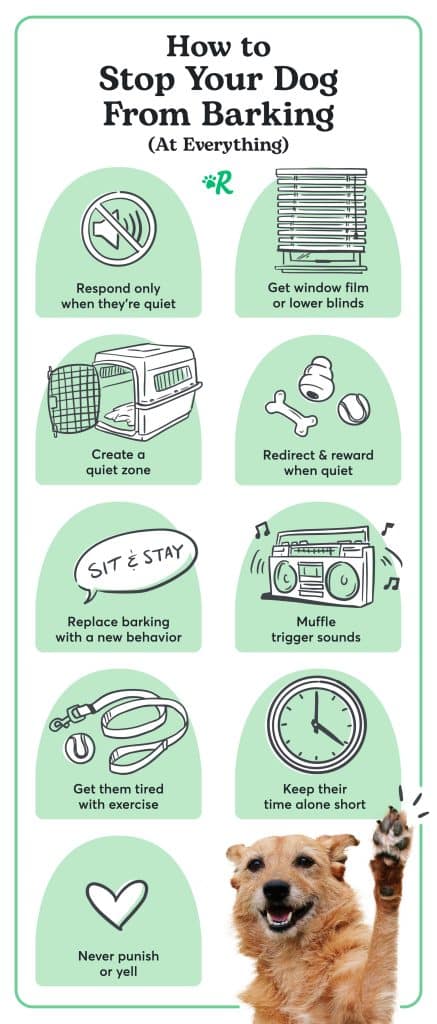
Tips to Stop Your Dog Barking at Night
Here are some of the most effective ways to help your dog settle at night.
1. Get a white noise machine
If your dog barks at other dogs and noises, a white noise machine may help drown out those sounds. White noise machines are also known to help people sleep, so it’s a win-win for both of you.
White noise machines are a good place to start, especially if it seems like your dog is barking at nothing. Dog ears are a lot more powerful than human ears, which means they might be picking up on sounds you can’t.
2. Focus on exercise and enrichment
Physical exercise and mental enrichment are equally crucial for helping your dog get into a relaxed mindset. A nighttime walk, play session, or puzzle toy routine can help your dog release any pent-up energy.
Lick mats and chewing activities also trigger your dog to release endorphins, which can help with relaxation.
3. Don’t go to your dog when they bark
It gets worse before it gets better, but ignoring your dog is how you’ll convince them that barking and whining won’t bring you to them. Don’t go to your dog. Don’t call out soothing words or shout at them.
If you comfort your dog even once, they’ll believe barking works. Even if you aren’t going to your dog every time, they’ll keep barking in hopes that the next bark will work.
Take away the reason for barking, and eventually the behaviour will stop because their strategy no longer works.
4. Make an appointment with a trainer
Ignoring won’t be easy, but if you don’t see progress after a week, you may want to work with a dog trainer. Dog trainers offer an alternative perspective and may be able to develop a solution plan for ongoing barking.
5. Talk to your vet about calming aids
If you’ve determined that your dog needs extra help outside training, talk to your vet about calming aids. An Adaptil collar or calming pheromone diffuser releases a scent that’s been shown to help dogs relax.
6. Sleep closer to your dog
Not forever. If you stopped abruptly on your pup, try going back to square one and gradually moving out of the room. Keep in mind, this may not work for all dogs, but some dogs do benefit from a slower transition in routine. Puppies who struggle with sleeping through the night may need additional help with puppy crate training.
If you don’t have a legitimate reason for confining your dog at night in another room, allowing them to sleep in your bedroom or even in your bed is perfectly fine. Some studies even suggest that sleeping with a dog in your bed will give you a better night’s sleep.
7. Avoid anti-bark devices
Bark collars are designed to provide negative reinforcement so that a dog stops practising a specific behaviour. They come in the form of electronic collars, spray collars, and ultrasonic collars and aren’t recommended by vets. Dogs barking out of fear and anxiety will only learn to be more afraid if their actions are paired with pain.
Completely eliminating barking as a behaviour shouldn’t be your goal. Barking is a crucial method of communication for your dog. Instead, you should teach your dog when to speak, so they learn when it’s appropriate to bark and when it isn’t.
8. Be patient and take naps
Stopping your dog from barking at night won’t be easy. When you are trying to change a behaviour like barking at night, you’ll experience an “extinction burst”. This means the barking will get worse before it gets better, as your dog desperately tries to communicate using a strategy that previously worked.
Of course, this also means that your sleep is going to get worse before it gets better. Make things easier on yourself by using earplugs. Permit yourself to take more naps than usual to make up for the lack of sleep at night.
Top Tip: Tell Your Neighbours You’re Working On It
The process of getting your dog to stop barking at night can take anywhere from two weeks to a few months. If you anticipate the noise bothering your neighbours, we recommend giving them a heads-up that you’re working on it. Send them a note with a voucher or earplugs.
For dogs who have a strict routine, you may discover that their barking habits return when you change the environment or schedule. If they do, go back to our tips above and with a bit of patience and practice, your dog should fall back into their quiet routine.
Another extra tip? Early communication can go a long way toward easing the anxiety that comes with the uphill battle of dog barking. This is especially true if you need to board your dog at a sitter’s home or a kennel. The less surprising your dog’s bark is to people, the less frustration they may feel.