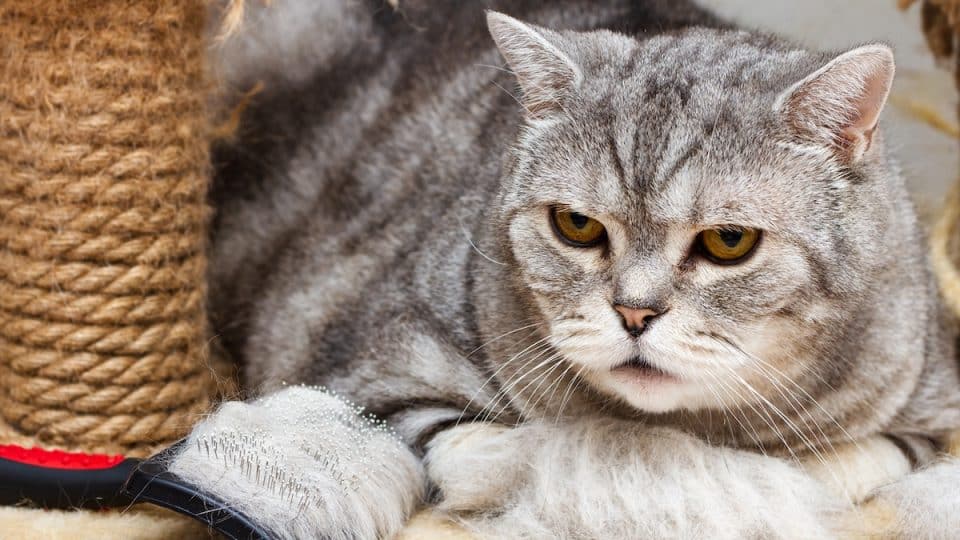
While some cats leave mere sprinkles of their hair scattered around the floor, other cats seem to be cursed with a coat that sheds to infinity and beyond, blanketing everything in your house.
Shedding is a natural and healthy process in cats, but that doesn’t mean you need to surrender to the hairy takeover. Understanding why cats shed, how much is normal, and how to recognise problems that call for a visit to the vet can help you fight off the furry invasion.

In this article, expert vets review practical tips and solutions for how to reduce cat shedding in your home.
How To Reduce Cat Shedding
Contrary to popular belief, bathing a cat and shaving them aren’t good ways to reduce cat shedding. Better solutions are regular brushing, dietary changes, and a low-stress environment.
1. Brush your cat at least once a week
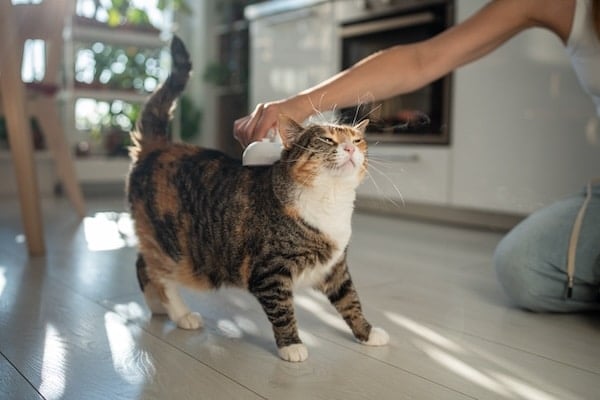
The best way to get a handle on cat shedding is the most obvious: brushing and combing them. How often to brush a cat to reduce shedding depends on the length of their hair.
If you’re actively trying to reduce shedding, Dr. Dwight Alleyne, a Georgia-based small animal veterinarian with JustAnswer Veterinarian, says to brush your cat at least once a week. That frequency is generally enough for short-haired cats.
Medium-haired cats need to be brushed at least two to three times a week. And long-haired cats like Maine Coons, Ragdolls, and Persians often need daily brushing, especially if they’re prone to matting.
2. Add Omega-3s and -6s to their diet
Prioritising essential fatty acids such as Omega-3s and Omega-6s can help reduce shedding, says Dr. Alleyne. Cold water fish like salmon, tuna, and sardines are naturally rich in those fatty acids and can easily be bought in high-quality commercial wet cat foods.
Omega-6 and Omega-3 fatty acid supplements can also be given to heavily shedding cats, along with Biotin and Vitamin E to support a healthy coat.
Remember to talk with a vet first before putting your cat on a new meal plan or giving them supplements. Abruptly changing your cat’s food can cause digestive and gastrointestinal problems—and as a result, food aversion and a refusal to eat.
3. Ensure your cat is hydrated
Whether your cat eats a dry kibble or wet food diet, don’t forget about making sure they’re drinking enough water. Dr. Alleyne says hydration can keep your cat’s hair from drying (and falling) out. Faucet-style fountains are a popular way to convince your kitty to drink more.
4. Minimise environmental stressors
Increased shedding in your cat can also be caused by increased stress. Common stressors include changes to your cat’s environment (like the addition of new human or animal family members), moving to a new home, or changes in routine.
To minimise your cat’s anxiety and to help reduce stress-fueled shedding, here are a few things to consider.
- If you adopted a new cat or kitten and your kitty is having a hard time adjusting, make sure you have enough essential resources, like litter boxes, food bowls, and scratching posts, scattered around the house.
- Making sure you have enough enrichment and mental stimulation for your cat. That might include sessions of predatory play and opportunities for them to engage in their instinctive behaviours like climbing and scratching. (As a bonus, you can also add in a little extra enrichment by getting your kitty a freestanding self-grooming arch and scratch pad.)
- If you suspect separation anxiety and loneliness are at the root of your cat’s sudden shedding, consider hiring a cat sitter to give them a little extra loving while you’re away.
Dima Berlin via iStock
How To Keep Cat Hair From Taking Over Your House
You can’t stop a cat from shedding, but here are four simple ways to combat a cat hair invasion.
1. Make a habit of vacuuming
Sure, you can splurge on the latest state-of-the-art robo-vacuum and give it free rein to zoom across your carpets, but you don’t need to blow a big budget on a pet-hair vacuum. As long as it’s capable sucking up those tumbleweeds of cat hair, you’re good as gold. For extra cat hair removal power, consider a handheld vacuum as well as a traditional stick one. Vacuum at least once a week to remove the most hair.
2. Use furniture covers
Washable furniture covers are effective barriers to keep cat hair off couches, chairs, and even beds. If you don’t want to use the furniture covers specifically designed to keep cat hair off, you can use sofa pads, blankets, sheets, or heavy linens that can be easily vacuumed and cleaned.
3. Install air purifiers
Air purifiers are an often-overlooked way to reduce cat hair in the home. Choose a HEPA model, ideally one specifically designed to suck in cat hair particles. They come in dozens of different sizes and shapes with different functions and settings, so be sure to research which ones are best for your specific situation and needs.
4. Invest in good shedded hair removal tools
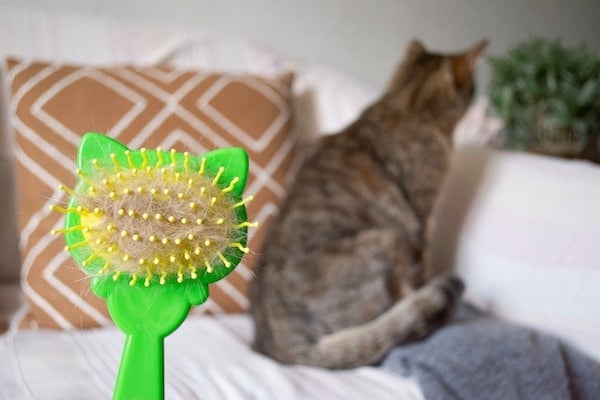
Shedded cat hair is notorious for sticking to clothing. If you don’t want to look like a walking hairball, there’s an arsenal of affordable cat hair removal tools you can invest in to banish those pesky strands. Reusable and disposable lint rollers, velvet brushes, and silicone or fabric hand brushes are the best of the bunch when it comes to keeping cat hair off your clothing and accessories.
Викентий Елизаров via iStock
Is Cat Shedding Normal?
“Shedding is a normal and healthy process for cats, which provides several functions,” Dr. Eryn Henke, Lead Veterinarian and Partner at CityVet Edmond, explains.
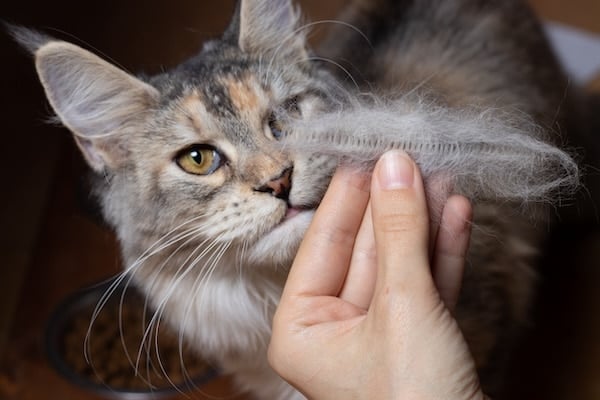
For one, shedding maintains their fur and skin health by eliminating damaged and dead hair and distributing natural oils.
It’s also an essential part of your cat’s thermoregulation. In the spring and summer, they shed that coat for a much lighter one to stay cooler. Spring shedding is especially helpful, since cats are unable to sweat to regulate their body temperature.
So if you notice your cat shedding a lot when the seasons change, it’s not usually a cause for concern. “Cats have normal adaptations in shedding patterns to adjust to changes in weather,” Dr. Henke summarises.
Factors That Affect Cat Shedding
“There is no specific guideline to the amount a cat should shed,” Dr. Henke says. “Cats have their own shedding cycles that differ from cat to cat.”
- Breed. Even though there isn’t a definition for normal shedding, generally speaking, based on hair volume alone, long-haired cat breeds like Maine Coons, Norwegian Forest Cats, and Persians shed more than short-haired cat breeds.
- Seasons: In the winter, when temperatures plummet (especially in the Northern Hemisphere), growing a thicker coat of hair helps your kitty stay warm.
- Indoor/outdoor lifestyles: Outdoor cats who are directly exposed to the elements, like summer sun and cold winter mornings, also tend to shed more than indoor cats. Indoor cats experience less extreme temperature shifts, so their bodies don’t need to thermoregulate so dramatically with hair growth and loss.
Yulia Ermilova via iStock
When To Talk To Your Vet
“Shedding becomes abnormal and problematic when a previously normal, healthy coat begins to show visible trauma to the coat and skin,” Dr. Henke says.
Abnormal shedding, also known as pathologic shedding, is highly visible, Dr. Henke explains. Cats with excessive shedding might have hair thinning (also known as hypotrichosis) or hair loss (alopecia). You might also see painful-looking skin damage that appears as red and inflamed, scaly and scabby, or as patches of red bumps.
Hair loss in cats can be a sign of serious illnesses, so it’s essential to visit your vet if you see symptoms. Dr. Henke says the most common diseases and illnesses that can cause excessive shedding and hair loss in cats include:
- Dermatitis and skin infections
- Autoimmune diseases
- Endocrine disorders like hypothyroidism and hyperthyroidism
- Pruritus (excessive itching)
- Parasitic infections
- Allergic reactions
- Poor nutrition and deficiencies
- Overgrooming
Beyond the visible hair loss from excessive shedding and skin damage, Dr. Henke says other shedding red flags to look out for include:
- A dull, greasy coat
- Matted fur
- Dandruff
- Significantly increased or decreased appetite
- Drastic, sudden weight loss
- Increased vocalizations
- Lack of or a reluctance to groom
“Anything that varies from a healthy coat is considered abnormal and should be evaluated,” Dr. Henke advises.