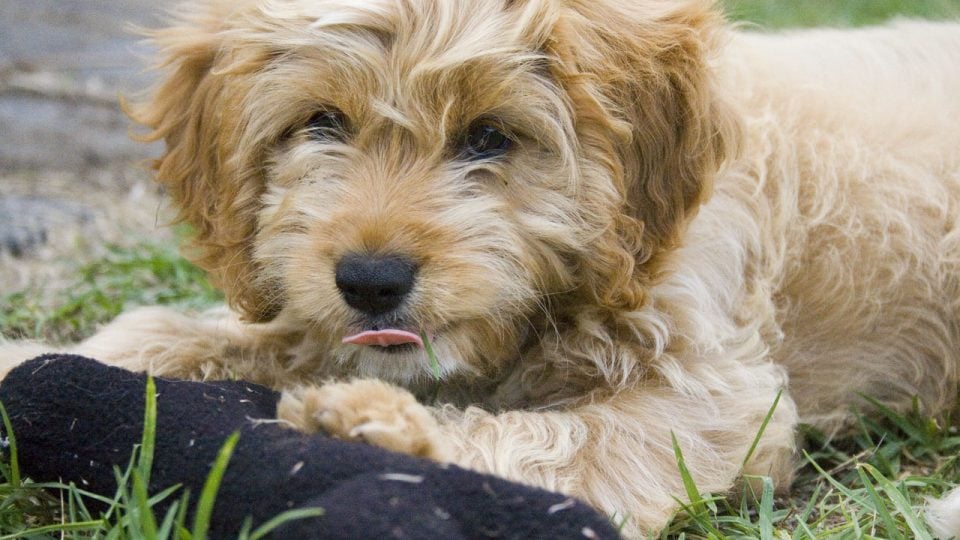
If you’re looking for a dog that’s both smart and gorgeous, a Cavoodle (also called a Cavapoo or Cavadoodle), might just be the breed for you.
This mix between a Poodle (miniature or toy) and the Cavalier King Charles Spaniel is one of the most popular designer dog breeds, for many reasons.

If you’re thinking about getting a Cavoodle—or if you’re just interested in learning what makes this breed so popular—stick around. This is everything you need to know about the Cavoodle.
Breed characteristics
- Origin: Australia
- Size: small
- Lifespan: 10-15 years
- Energy level: medium/high
- Breed group: toy dog/designer dog
Breed appearance
https://www.instagram.com/p/B5_EbS1Ak-D/
Since it’s a mixed breed, Cavoodles may take on characteristics of either parent breed, and may favour either the Cavalier King Charles Spaniel or Poodle more—or possess a unique mix of both breed characteristics.
Either way, it’s difficult to predict exactly what each Cavoodle pup will look like as it grows into an adult dog. In fact, it’s not uncommon for Cavoodle pups of the same litter to look like entirely different dogs.
As far as size goes, we have to look at the parent breeds to find out what to expect with the Cavoodle. The Cavalier King Charles Spaniel is a relatively small dog, in the toy category, standing 30-33 cm tall when fully grown, and weighing between 6-8 kg.
The Toy Poodle has a different body structure, standing not much shorter, at around 25 cm tall, yet weighing much less, at only 2-3 kg.
You can expect your Cavoodle to fall anywhere between the sizes of their two parent breeds, but thanks to varying trends in breeding the Cavoodle, it’s even more complicated than that.
According to Pet Guide, there is a lot of variation in the Poodle breed used to parent Cavoodles, which means there’s a lot of variation in the size of Cavoodle dogs. While Toy Poodles are common, Miniature Poodles are often used as well.
Miniature Poodles are slightly larger than Toy Poodles, standing 25-38 cm tall and weighing 4-7 kg—much closer to the size of a Cavalier King Charles Spaniel. A Cavoodle bred from a Miniature Poodle will probably grow to be larger than other Cavoodles bred from a Toy Poodle.
Just as unpredictable is the coat of the Cavoodle. It may have silky and wavy hair like the Cavalier King Charles Spaniel, or a thick coat full of curls like the Poodle.
Cavoodles have a wide range of colour possibilities, as do their parent breeds. They can be red, chestnut, brown, brown and white, black, black and white, tricolour (black, white, and tan), tan and white, silver, grey and white…. the possibilities are nearly endless.
Cavoodle Grooming
https://www.instagram.com/p/B5_ABPaBitv/
If your Cavoodle has hair more like the Cavalier King Charles Spaniel, it will need regular baths every couple of weeks, followed by a thorough brushing to keep tangles at bay.
If his hair is more like a Poodle, brushing will need to be more frequent, daily brushing to keep mats at bay—and that brushing needs to go to the skin, or the mats will exist (trust us on this one!).
Either way, your Cavoodle will probably need to see a groomer every four to six weeks. You may ask that their hair be cut shorter to reduce the time you need to spend with a brush in your hand.
Another common grooming issue with Cavoodles is tear stains, something that’s common with both parent breeds. Washing the area under the eyes daily is the best way to keep this unsightly problem at bay.
Cavoodle personality
https://www.instagram.com/p/B5-jiAzB8bL/
The Cavoodle comes from two treasured breeds, so it makes sense that the combination would result in a truly delightful dog.
Cavoodles are gentle and friendly, and their very social nature means they usually don’t know a stranger. Still, they tend to reserve their greatest affection (and they have a lot of it) for their families.
They’re also extremely loyal and value human companionship—often even over that of other dogs. They think of themselves as one of your pack pretty quickly after joining your household, and they can sometimes get rather clingy.
Don’t be surprised if you soon have a fluffy shadow following you everywhere soon after bringing home a Cavoodle.
Ideal Environment
https://www.instagram.com/p/B5-xVVZhyy2/
Cavoodles can adapt to nearly any environment and will thrive in a house or a small apartment, and they’ll be happy in the city or a country setting.
Since the Cavoodle is directly related to the Cavalier King Charles Spaniel—a notorious lap dog—they would happily spend the day on the couch. This means they don’t take up very much space and don’t necessarily need a garden.
However, they also carry Poodle genetics, and Poodles are fairly athletic dogs. They should go on one or two short walks per day—just around the block is probably enough—but potentially more if they don’t have access to a garden.
If your Cavoodle has a garden, it’s imperative that it’s fenced. Thanks to its relation to the Cavalier King Charles Spaniel, the Cavoodle harbours some hunting instincts (they may be deeply buried, but they’re there), and is likely to take off if it catches the scent of something interesting. So good recall training is important if you plan to walk your Cavoodle off lead.
Ideal Human
https://www.instagram.com/p/B5-tS4Yh9xg/
There aren’t many people who wouldn’t do well with a Cavoodle in their life.
Because of their small size, Cavoodles are great choices for seniors, retirees, or singles living in small spaces.
They’re also great with kids and will happily join in with gentle play—but they usually do better with older children able to play without hurting these small, sometimes fragile dogs.
Since Cavoodles get so attached to their families, they rarely do well when being left alone for extended periods of time, and they are notoriously hard to kennel. For this reason, Cavoodles do best in households where at least one person is home most of the time.
Training a Cavoodle
Since they’re always so eager to please—a trait they’ve inherited from the Poodle—you’ll likely find that your Cavoodle is a highly trainable dog.
Not only can they learn basic commands fairly easily, but you may also teach them fun party tricks, especially if you start while they’re still puppies.
The key to training a Cavoodle is to remain positive. Match their excitement by praising each success with great enthusiasm (and their favourite treats), and keep the sessions short, fun, and often. Repetition will be your best friend in training your Cavoodle.
Breed Health
https://www.instagram.com/p/B5_BGZiFwaN/
According to the Institute of Canine Biology, a recent study gave evidence that mixed-breed dogs are often less likely to develop genetic disorders than their purebred counterparts. This means that while there’s never a guarantee your Cavoodle will be in perfect health, it has a better chance of not falling victim to the genetic issues that plague their parent breeds.
Of course, Cavoodles are still at risk of any health issues their parent breeds are predisposed to, so we must look at the Cavalier King Charles Spaniel and Poodle for clues about what health issues owners might expect to run into with Cavoodle dogs.
Cavalier King Charles Spaniels, unfortunately, are prone to many health issues. Their biggest health risks usually involve eye disease, dislocated kneecaps and hips, heart valve problems, ear infections, and even neurological disorders. You can catch most of these issues with early screening and are largely treatable under a veterinarian’s supervision.
While Toy Poodles are typically healthy thanks to responsible breeding, they have a few issues to look out for. Toy Poodles, like Cavalier King Charles Spaniels, are predisposed to eye issues and dislocated hips and knees. They also may suffer from idiopathic epilepsy and immune-mediated disorders.
History of the Cavoodle
https://www.instagram.com/p/B5_F1yxhGda/
We know that many breeds of dogs have been mixing for many years (probably as long as dogs have existed), but designer dogs—breeds intentionally crossed to create a new, ‘designer’ breed full of desired and carefully selected traits—are fairly new.
Designer dogs really started to pick up popularity in the 1990s and the Cavoodle was one of the first. The first recorded litter was born in Australia. After that, it wasn’t long before the breed could also be found in the United Kingdom and the United States.
To understand the history of these dogs, you have to look to their parent breeds for more information.
Cavalier King Charles Spaniels go all the way back to the days of the Renaissance when toy Spaniels were often found in the company of royalty. They remained unchanged and with their noble companions until the 19th century when they were crossed with Asian toy breeds like Pugs, giving them flatter faces.
Eventually, the flatter-faced variety, known as King Charles Spaniels, became the most popular and the old style slowly disappeared. That is, until the 1920s when a wealthy American decided he’d like to own a dog that looked like the ones his British ancestors had loved. He even offered prize money to any breeder who could create the old-style Spaniel. This new version of the old breed was called the Cavalier King Charles Spaniel, and it’s the breed we know and love today.
Toy Poodles, of course, started off as Standard Poodles, and originated in Germany as water-retrieving dogs. Thanks to their curly, waterproof coats, high intelligence, and talents in swimming, they fit the bill for this duty with ease. The familiar styling of the Poodle, with their shaved tails, legs, and necks, was actually started out of practicality during this time—it gave them more ease of movement in the water, but kept their most important parts shielded from the elements.
When they moved from working dogs in Germany to more elegant companions in France, Poodles started appearing in smaller sizes, giving way to the toy and miniature varieties that are so popular today—both of which are sometimes used in breeding the Cavoodle dog.
Getting a Cavoodle dog
https://www.instagram.com/p/B5-blUth7z5/
Bringing a new dog into your home is not a decision to make in haste. Not only do you need to evaluate whether a dog fits in with your lifestyle, family, and home, but you also need to take some time to figure out what breed of dog is best suited to you.
If you’ve decided on a Cavoodle after weighing all the pros and cons, you’re in for many years of entertainment and unconditional canine love. But deciding on a dog is only the first hurdle you’ll encounter. Now it’s time to track down a Cavoodle.
The two most popular choices for finding Cavoodles are through breeders and rescue organisations. Both options have negatives and positives, so it depends entirely on what type of adoption experience you’re looking for, and what’s available in your area.
Cavoodle rescues
Since Cavoodles are a new breed, there may not be a lot of options for finding one through a rescue organisation, but it is possible. Internet searching will turn up options for rescued Cavoodles, but you may have to travel to find one. When you find an organisation, do your research and ask questions to make sure they’re reputable.
There may be drawbacks to adopting a Cavoodle dog through a rescue organisation. It’s likely the dog you find will not be a young puppy, and you may not learn much about its past. Though, most pet rescues report dogs being given up simply because their pet parents have a change in circumstances, rather than behavioural issues or abandonment.
However, its age may also be a plus—there’s a good chance an adult Cavoodle will be house-trained, and it will probably have been socialised. It will also have been spayed or neutered and will have received all of its required immunisations.
All of this reduces the cost of ownership for you—as does the adoption fee, which is usually much cheaper than the price of purchasing a Cavoodle from a breeder.
Cavoodle breeders
It’s often more difficult to find reputable Cavoodle breeder since they are not a breed registered by the Kennel Club, and therefore won’t be listed among their approved breeders. Before you commit to a Cavoodle breeder, ask around—your vet or other local breeders may be a good resource. Be sure to do plenty of research about how to avoid puppy farms or internet scams.
When you visit, be sure to ask about any health issues in the dog’s bloodline, and discuss any genetic tests you might want to run.
More on Cavoodles
Want to know more about Cavoodles? Rover has you covered with plenty of info about their parent breeds.
- Here’s Everything You Probably Don’t Know About Poodles
- Poodle Puppies: Everything You Need to Know
- The Real Stories Behind the World’s Most Expensive Dogs
For more information on what it’s like to buy and care for a dog, here are a few resources to get you started.
- Popular Dog Breeds
- The True Cost of Getting a Dog
- How to Adopt a Dog: Your Complete Guide
- The Best Dog Names for Every Type of Dog
- The Best Dog Chews
Feature image: Flickr