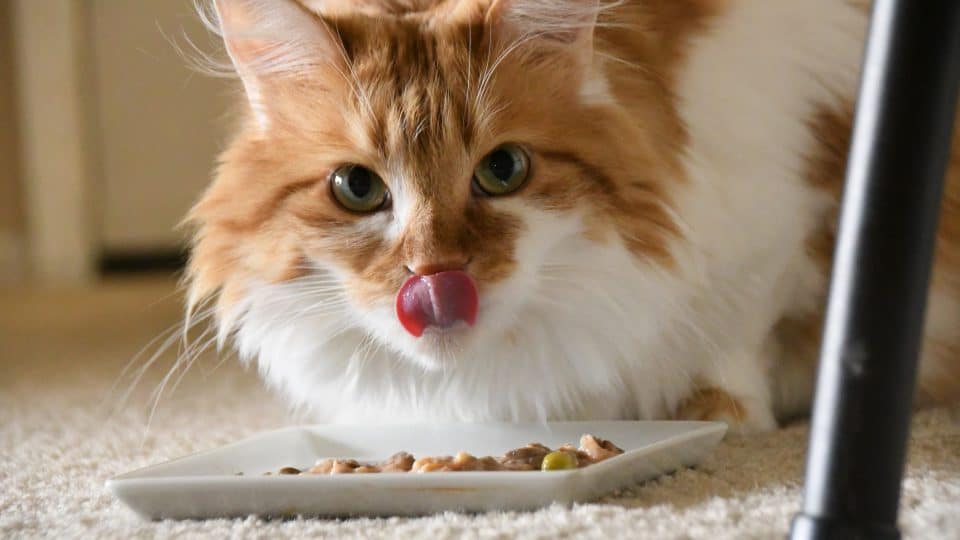
Whether you’re a new cat parent or a seasoned pro, feeding your cat the right amount can be tricky. Each cat can have different dietary or caloric needs based on their age, activity level, and more. And serving the correct amount of food is essential to your cat’s overall health and well-being.
Let’s explore expert guidance on how much, what type, and how often to feed your feline friend for optimal health and happiness.

How Many Cups or Calories to Feed Your Cat
Most adult cats thrive on two meals per day. Generally, the average adult cat should weigh around 10 pounds (4.54 kg) and eat about 1/3 to 1/2 a cup of food per day. That’s equivalent to around 250 calories.
Cat feeding guidelines by weight
Divide the total amount of food into two meals. Some cats may prefer one meal a day.
| Weight (kg/lbs) | Cups (dry food)* | Kilocalories/day |
| 1 / 2.2 | 1/4 to 1/3 cup | 100-130 |
| 2 / 4.4 | 1/3 to 1/2 cup | 160-170 |
| 3 / 6.6 | 1/2 cup | 200-210 |
| 4 / 8.8 | 1/2 to 2/3 cup | 225-250 |
| 5 / 11 | 2/3 to 3/4 cup | 250-290 |
| 6 / 13.2 | 2/3 to 1 scant cup | 256-330 |
| 7 / 15.4 | 3/4 to 1 cup | 280-370 |
| 9 / 20 | 1 scant to 1 generous cup | 325-439 |
*Measurements based on Purina Cat Chow Naturals Original
Another way to measure how much to feed your cat is to calculate 20-30 calories per pound (44-66 calories per kg) of body weight, says Dr. Sabrina Kong, DVM, a staff veterinarian at WeLoveDoodles. If you are still unsure of the amounts, consult your vet.
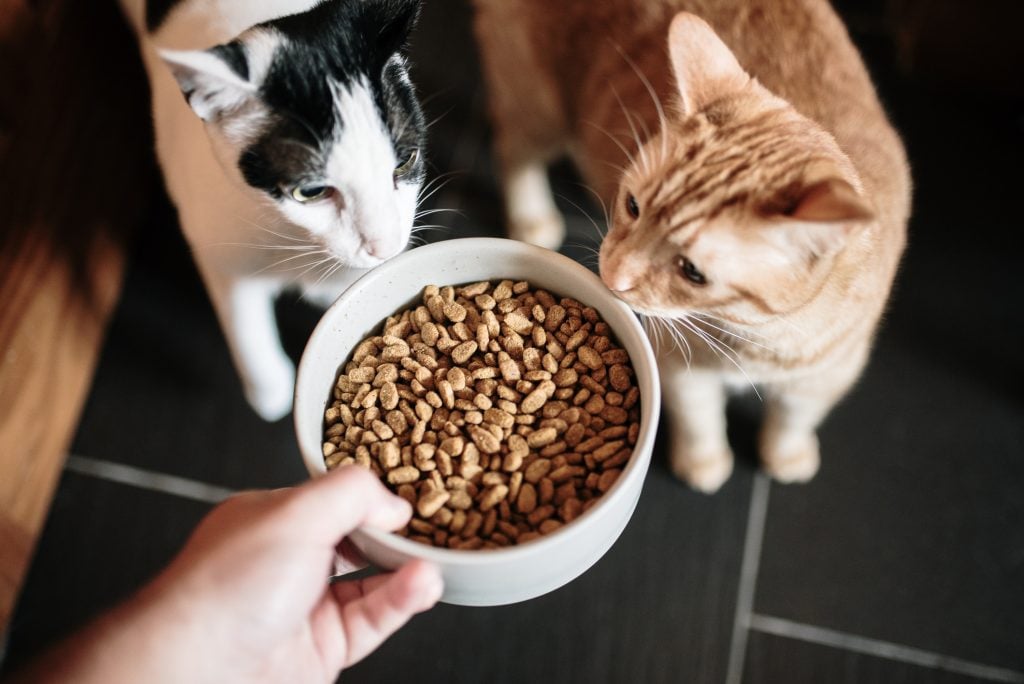
Dr. Jo Myers, DVM, a veterinarian at Vetster, advises against free feeding after six months of age. “Most cats are not hardwired to automatically refuse to eat more when they’ve already had enough. Giving in to their demands usually results in obesity,” she warns.
The body-condition score can help assess if your cat is the right weight.
MarioGuti via iStock
Factors Affecting How Much You Feed Your Cat
Trying to fine-tune your cat’s diet? Consider these critical factors, which help guide whether your cat needs a little more or less than the recommended portion.
1. Cat preference for flavour and brands
Some cats are finicky eaters and will wait for food they like. For each new flavour or brand you buy, look at the calories per cup. You may need to adjust portion sizes based on the brand’s formula.
2. Age and activity level
According to Dr. Kong, adjusting food portions based on each cat’s lifestyle is vital to maintaining a healthy weight. Kittens require at least three to four meals a day to support their growth and energy until they are six months old. After six months, kittens should transition to meals twice a day.
Young, active cats generally need more calories to support their energy and growth, while senior cats benefit from easily digestible food with a lower calorie count.
3. Cat size and breed
Larger-framed cats will need more calories than smaller ones, but some breeds are also naturally more active than others. Chill, large cat breeds such as Ragdolls may need fewer calories than smaller, active cat breeds like Bengals.
4. Indoor vs. outdoor lifestyle
Indoor cats tend to be less active and require fewer calories, while outdoor cats use more energy and need extra food to sustain them.
Some outdoor cats may get extra calories by hunting small animals or tricking their way into a second home. For those clever cats, it’s even more important to keep an eye on their figure and feeding amounts.
5. Spayed or neutered status
Spayed or neutered cats often show an increased appetite and are more prone to weight gain, particularly when allowed to free-feed. Dr. Myers recommends portion-controlled feeding for neutered cats to avoid overeating.
6. Health conditions
Cats with specific conditions like diabetes, thyroid issues, or pregnancy will have unique dietary needs. For example, cats with hyperthyroidism may need more food due to an elevated metabolism, while lactating cats can require up to four times their usual food intake.
Always consult your vet if your cat has any special health conditions affecting their feeding requirements.
CasarsaGuru via iStock
Wet vs. Dry Food: What’s Best for Your Cat?
Choosing between wet and dry food is a matter of health, preference, and lifestyle. Dr. Stacy Choczynski Johnson, DVM, says that both wet and dry foods can be beneficial depending on your cat’s specific needs.
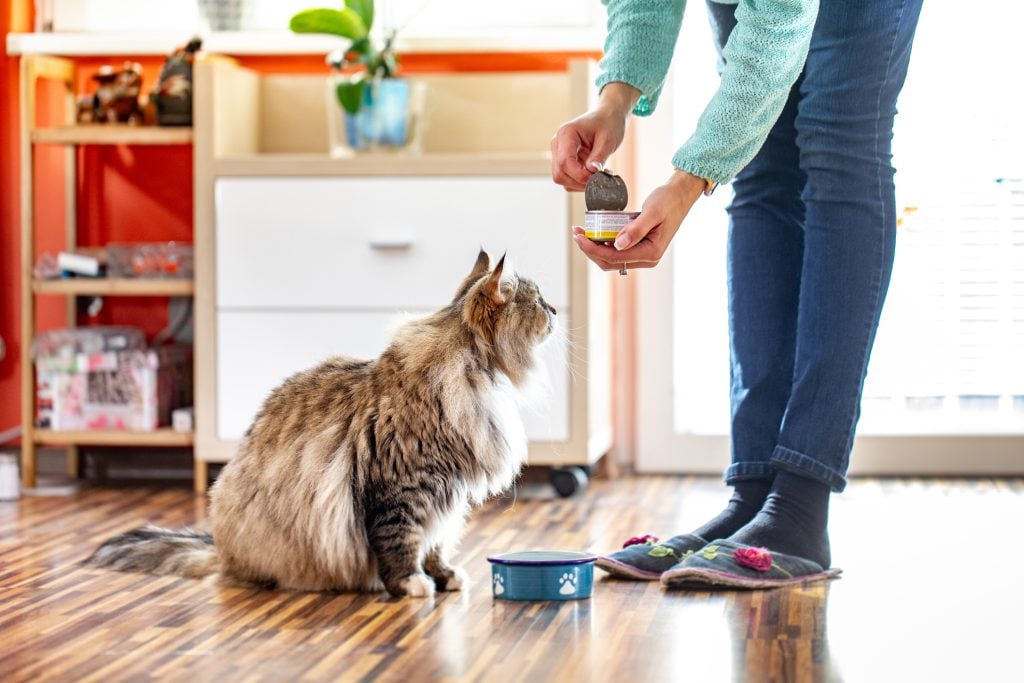
- Wet food: At 70 to 80% water, wet food offers extra hydration for cats prone to dehydration or kidney disease. Many pet parents serve it at set times, making it easier to control portion sizes.
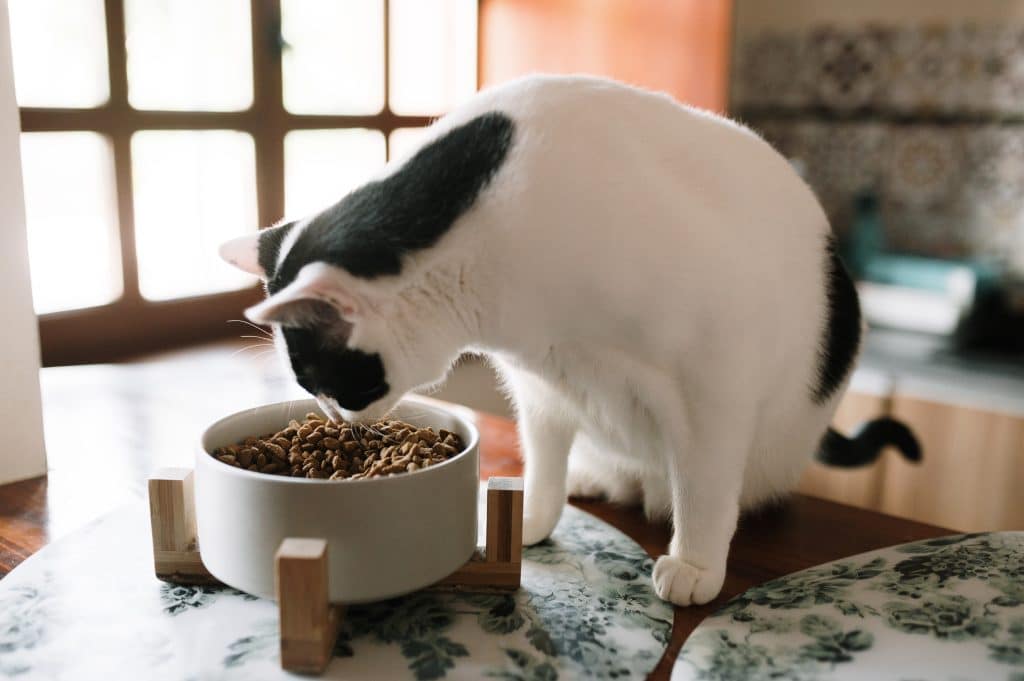
- Dry food: Convenient for “grazers” who like to eat slowly throughout the day. However, dry food tends to have more calories, so measure portions carefully to avoid overfeeding. Combining dry food with teeth brushing can also support oral health.
Pro tip: Let an automatic feeder take on the responsibility of feeding your cat on time.
How much wet vs. dry food?
“It’s okay to have the best of both worlds,” says Dr. Johnson. “Many households provide a dry kibble for grazing, whilst fixed meals that feature perishable wet food.” Monitoring calorie intake is even more critical if you are providing two different food types to your cat.
Here’s a rough guide of how much wet food and dry food to feed based on the two popular cat food brands:
| Weight (lbs) | Tiki Cat Ahi Tuna (wet, oz/day) | Purina One Indoor (dry, oz/day) |
| 5.5 | 7.6 | 1.2 |
| 11 | 11.2 | 2.5 |
| 15 | 14 | 3.1 |
For comparison, Tiki Cat’s Ahi Tuna Recipe wet food contains 25 calories per ounce, while Purina One +Plus Indoor Advantage dry food has about 110 calories per ounce.
Homemade cat food: If you’re interested in making your cat’s food, ensure you’re meeting their specific amino acid requirements (e.g., taurine). Dr. Johnson recommends avoiding homemade or raw food due to the risk of improper nutritional balance. However, if you are set on homemade food, check resources like balanceit.com or consult a pet nutritionist.

Kannika Paison via iStock
Recognising When To Adjust Portions
Cats’ calorie needs may fluctuate over time due to age, health, or activity levels. Regular feline wellness exams help monitor body condition and weight, allowing you to adjust portions as needed.
Here’s when you may need to increase or decrease your cat’s food:
- Increase for: growing kittens, pregnant/lactating cats, active outdoor cats, underweight cats, or large breeds.
- Decrease for: senior cats, low-energy indoor cats, or cats who tend to overeat when free-fed.
Feeding a cat with high calorie needs can be tricky. Sometimes, it’s simply a matter of offering an extra daily meal. But if you have to offer meals larger than your cat can comfortably finish in one sitting, it might be better to switch to a more calorie-dense diet, like kitten food.
MarioGuti via iStock
Can You Trust the Package Recommendation?
While there are general guidelines for feeding cats, the perfect diet is as unique as your cat. If math isn’t your forte, use the feeding guidelines on the pet food label as a starting point.
Dry cat food labels often state the product’s calorie content in two ways: kilocalories per kilogram and calories per cup. A standard measuring cup works for portioning cat food.
How accurate these recommendations are depends on the factors mentioned above and the brand you’re buying. Some labels, Dr. Myers points out, aren’t always backed by science and often give gross overestimations.
But we know cats don’t always eat the brand you wish they would. That’s why you’ll need to check your cat’s figure between their annual exams or after a few months, if you switched them to a new food or portion size.
If all is well, use your cat’s annual exam to check in with your vet. Your vet will let you know if you need to adjust their feeding routine.